
eXtensions - Monday 1 June 2026
By Graham K. Rogers
Some of the lines seem to have shifted with AI in the past few days. The Pope made widely reported comments on the use of technology and AI. Many have given considerable thought to this. Users are also becoming more aware of the astronomical costs of using AI: data centers, power use, pollution; and the fees that come from using tokens. Companies are moving swiftly to limit their exposure. Halide III arrived this week and I am delighted by the update.
The Pope released an encyclical in 9 languages this week in which, among other things, AI was discussed. We also note a number of recent pronouncements about this new technology. Many are now wary of the acceleration in the use of AI. Some users beginning to understand just how much it costs them in money terms, even if the suggestion (or photo edit) is not incorporated. While a human brain uses an error as a learning experience, AI acts as if it is never wrong. On X, the Pope writes,
Artificial intelligences do not undergo experiences, do not possess a body, do not feel joy or pain, do not mature through relationships, and do not know from within what love, work, friendship or responsibility mean. Nor do they have a moral conscience, since they do not judge good and evil, grasp the ultimate meaning of situations, or bear responsibility for consequences. They may imitate or even simulate, but they do not understand what they produce, for they lack the affective, relational, and spiritual perspective through which human beings grow in wisdom. (Encyclical)
We also note a number of recent pronouncements about this new technology. It has captured the imagination, and the investments, of many. In an unrelated editorial about Peter Mandelson, a sentence in the first paragraph caught my eye: "What the wealthy and connected think makes them an asset is exactly what makes them a risk" (Guardian). As well as politics, the same may well apply to AI.
I commented last time on the AI manipulated color image that John Danziger had created from an original Ansell Adams black and white photograph. The Adams image is widely recognized as the work of the great photographer and not that of a gallery owner in New York. I did note last time that the copyright appeared to have lapsed and this is the apparent reason the unapologetic Danziger felt able to work on the image. As reported by Matt Growcoot Danziger claims, "It was indeed confirmed to be in the public domain and I was free to create a transformative color rendition of the image and to exhibit and sell the resulting prints." This was apparently out of love for the original. He is reported as saying, "AI served as the starting point but says the image was worked on for "months," with humans editing, proofing, and refining it." Good heavens. A team worked on it for months. It does not do any justice to the original image. In a note at the end, Matt Growcoot comments that as this new image is AI-generated it is ineligible for copyright protection.
A few weeks ago I was surprised by an article on Fstoppers by Craig Boehman that explained how AI was costing users more than they might realize when editing with Adobe products (and other software). He called it, "The Industry's Dirtiest Money Grab." I had to admit that, as a naive non-user of Adobe or AI, I was unaware of the significance of credits. For my one use of ChatGPT as part of the Mac's writing tools, I declined to turn on the pay version, and presumed that this was a subscription, not pay as you go. Alex Cooke (FStoppers) updates us on how Adobe has now added the ability to see how much any editing is about to cost. There could be a lot of money involved.
No wonder users are seeking alternatives.
This links with the more public pronouncements about how companies in particular have been using AI and their surprise at how much they have spent. Jon Martindale (Tom's Hardware) notes that the cost of these tokens is causing companies, such as Microsoft and Uber to refine "their strategies as costs mount". As an example (which was widely reported) Uber "had blown through its entire 2026 AI budget in just a few months". Those tokens must add up quicker than they realize. Microsoft has also gone through what it calls a "consolidation" - cutting costs. At this week's Build (WWDC for Windows), Microsoft is taking a roll-your-own approach on AI that avoids ChatGPT.
Some news reported in The Information newsletter concerns Apple. The Information (Paywall) is heavily into AI reporting and lauds many of the companies mentioned above, and hinted at by the Pope. The reporting is also not often positive about Apple. Aaron Tilley writes that Apple is to renew the push for AI to run on devices rather than in the cloud. That is interesting because if I read between the lines correctly, not linking to the LLMs online means that there are no fees for any transaction. No wonder Open AI is suing Apple because it isn't working out as fruitful as had been expected. Hartley Charlton (MacRumors) has more on this move to on-device computing. All may well be revealed at the upcoming WWDC. It has something to do with Apple's chip design that allows on-device processing, although we are told that cloud access will be needed for more complex queries.

When the Pope voiced his warning about technology and AI (see above), this was widely reported. Less so was information about another person there. "Christopher Olah, co-founder of Anthropic, was seated in a row of cardinals at the Vatican to personally present this document alongside the Pope. A 33yo atheist tech billionaire standing next to the leader of 1.4 billion Catholics telling the world that AI weapons must be stopped." This was on X this week and may be part of a strategy in litigation between the company and the US government. Nonetheless, Anthropic does seem to have ethics. And we should remember Geoffrey Hinton, sometimes called the godfather of AI. At his acceptance speech for the Nobel Prize in 2014 he warned against AI and outlined the risks. As a note, Illinois has produced a Bill to regulate AI companies with independent 3rd party audits. I first saw this on an NBC News item, and there is more information from Jeremy Gorner (Chicago Tribune) who notes that the governer of Illionois, JB Pritzker, intends to sign this. The Bill includes several protections for consumers, and for whistleblowers.
Other notable comments come this week from Om Malik who writes on "Anthropic, AI and The "Numbers" Problem". There is also an interesting comment from Jaron Schneider who did not enjoy the movie, Dreams of Violets, that was shown at the Tribeca Film Festival. He clearly does not support the use of AI for making movies. One of his many comments on the output is "What a terrible day to have eyes."

Having downloaded, without payment, much (if not all) of the content available online, and added some scanned books, for training OpenAI, Sam Altman wants users to treat it as a utility - water, electricity, gas - and pay for the pleasure of content. Presumably that includes the hallucinations and less than perfect writing. The multi-billion investments in chip technology, and data centers has to be paid for somehow. Amanda Caswell (Tom's Guide) comments that "From a business perspective, Altman's analogy is surprisingly logical" although businesses are already becoming alarmed about the costs. The only way for AI companies to retrieve the vast investments being made into the technology is to ensure that all users pay for the privilege. None of them has offered to pay for downloading my entire site several times. Free stuff in; users pay through the nose.
Couple this arrogance with the reactions of students recently in the USA, who let Commencement speakers know about their disagreement with what they were being told. A number of commentators are wondering if a tipping point has been reached. Despite the widely reported boos from students at graduation ceremonies when AI is introduced, some speakers have taken a different approach. Fareed Zakaria spoke recently at such a ceremony and did mention this, just to deal with the booing. His message embraced more the idea of Human Intelligence and did describe ways in which AI can be valuable. A video is available on his X feed and the ideas he expresses are worth considering
There are some developers who know that users, particularly those into photography like me, prefer to eschew AI when possible. One app that I have been using for a while is Halide. The developers have always had photography at the forefront of their offerings and about the same time as Halide was initially released, Sebastiaan de With produced a couple of articles on RAW photography that I still refer to: The Power of RAW on iPhone - Part 1 Shooting Raw; and Part 2 Editing RAW. Although internally there has been some disruption in-house at Lux Optics, the promised release of Halide III has arrived and this is a worthy update. I took to the new version like a duck to water, but if users are not entirely happy there is an option to return to Version 2.
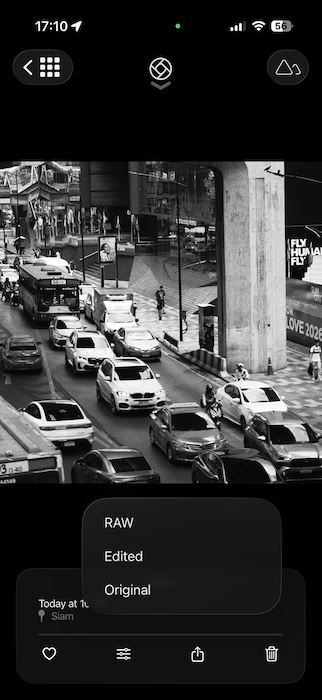
I certainly like the new filters, and selected Noir immediately because I like to view scenes without the distraction of color. Apple does not now allow that with RAW output on the iPhone 17 Pro (it was fine on the iPhone 15 Pro), but Halide does. I can leave that Noir filter on as the RAW image is saved and I can revert to the original if I want to use color, by accessing a control bar (above the tools) where there are controls for RAW, Edited and Original. By selecting RAW or Original, I can export the image and work on the color version.

|
|

|
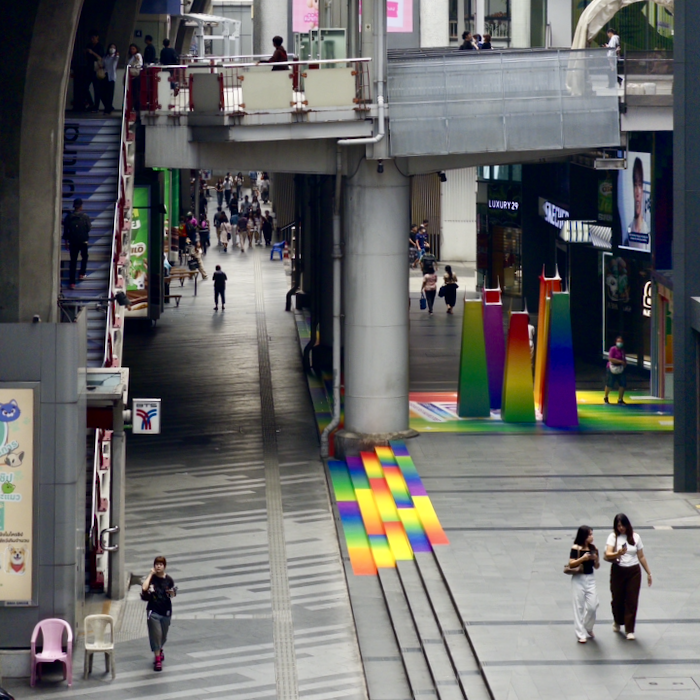
I am also impressed by the ability to edit images without the need to switch to an external editor, although the features within the Halide editor may take a bit of learning. I will use the long weekend (in Thailand) to go through camera settings to ensure they are as I want. For example, I added the grid and (for me) there were more squares than I like (9 is fine). I found that while writing this and changed the setting to the preferred Thirds.

|
|
I did experience a couple of crashes early on when moving between camera features, editing, and importing images from the Photos Library. All has settled down now. Those images now include Nikon RAW images (and RAW from other camera makers). The day after the 3.0 release, there was a further update bringing the version to 3.0.1. There was no information about the specific change in the App Store rubric, but this update was probably a minor bug fix.
|
|
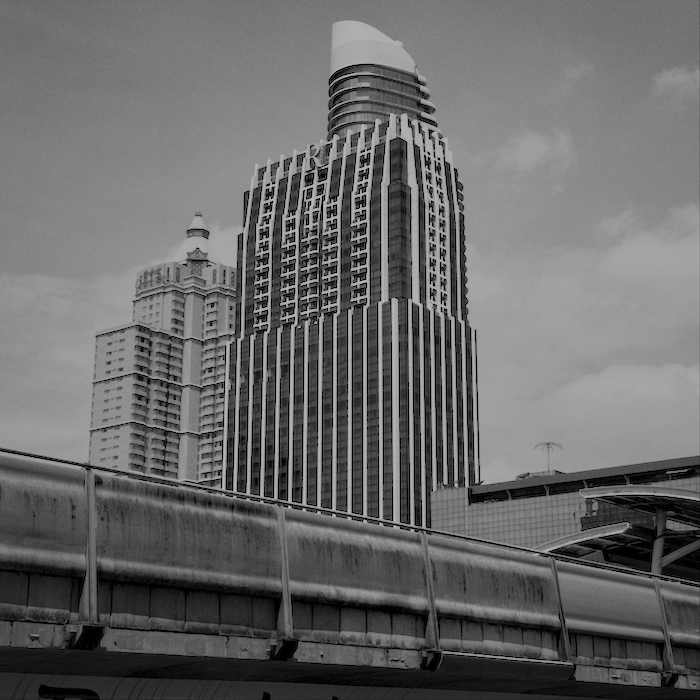
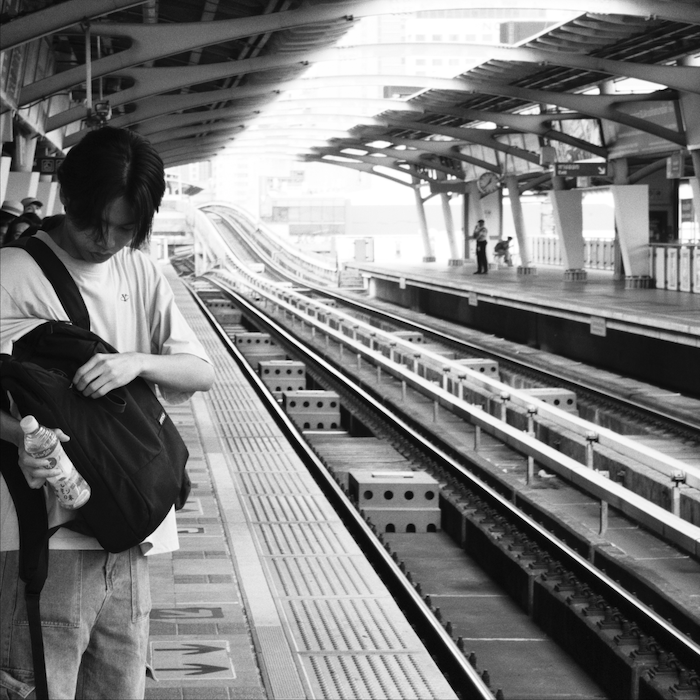
Apart from the images that I decided to use with color, there was almost no editing needed: brightness, contrast, shadows. The images I have here are pretty much straight out of the box.
In the second part of interviews between Horce Dediu, Tekeshi Narabe and Dylan Weir (Asashi Simbun), a couple of points made me sit up. Dediu mentions how strong Japanese manufacturing was in the 1970s and he puts this down to being constrained: capital, land, resources. These constraints taught Japan to be lean and efficient. He also mentions the Toyota Way and the idea of Just in Time. He goes on to mention how Steve Jobs and Apple were in awe of Japanese manufacturing, particularly Sony. I remember with some affection a Sony casette player I bought in the late 1970s which lasted for years. Dediu then comments, "one thing that I think Japan didn't understand starting in the late 90s was the power of software." That struck a chord with me as I remember Steve Jobs specifically mentioning how software was the key to the way the iPhone would work.
That sent me digging into the notes I had taken at the 2007 introduction of the iPhone. Just after the outline of why the buttons on the keyboards of the most popular phones at the time limited the experience - you can't change the buttons if you come up with a new idea 6 months down the road - Jobs mentioned that the iPhone runs OS X (stripped down and now much changed). Then he used a quote from Alan Kay (MIT, UCLA, HP Labs) who did early work on Object Oriented Programming: "People who are really serious about software should make their own hardware". In Part 1 of the interview extracts, Dediu mentions that for the iPhone, it was software, written by third parties [that discovered the compelling uses], and it developed in its own ecosystem. I had thought that this discovery by developers to release the potential of the device had been a factor mainly in the success of the iPad.
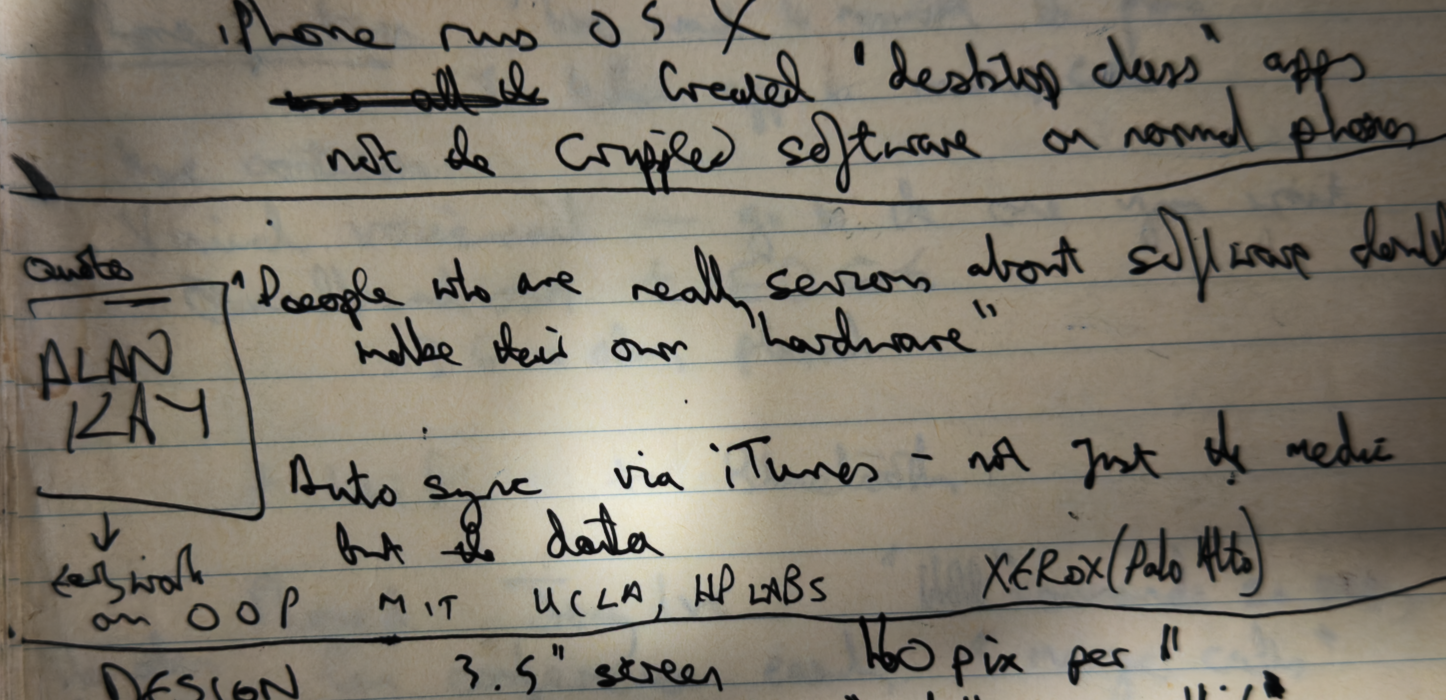
I also remember, however, my annoyance at MacWorld 2008, the year of the MacBook Air, when the iPod touch 2 was also released. I was miffed that the software update - basically making the iPod touch 1 into the second version - was not to be available for users in Thailand. Because of music copyright problems, there was no iTunes Store for users to download paid software at that time. I made my annoyance clear to a couple of Apple personnel with whom I was in contact in San Francisco. I also suggested a 2-tier store without music that would allow Thai users to access such downloads. "Hmmmm . . . I will pass that on", I was told. 6 months later the App Store appeared and this was available to Thai users. Great minds think alike.
There is much more in this series of excerpts from the Asahi Shimbun newspaper interview on Apple & Innovation: Part 1 (10 May), Integration, culture and market creation; Part 2 (25 May) The Story of Japanese Innovation. At this time Part 3 is yet to appear.
This Friday saw the final episode of the current series of For All Mankind, and on the same day, Apple released its other space-race series, Star City. We had a few brief looks at the brutalist architecture of the installation in the first series of For All Mankind, but this now takes us deeper into the program itself which, in this fictionalized alternative, has the Soviets landing first on the Moon. I watched the first 2 episodes at the weekend and was impressed by the sharper presentation here: far more action than I expected. The cast is good, even the minor characters come across strongly. Rhys Ifans is powerful playing the Chief Designer (remember his lovable fool in Notting Hill); and Anna Maxwell Martin is brutal (and cold) as Colonel Lyudmilla Raskova, head of the KGB at Star City. A report by Ryan Christoffel (9to5Mac) outlines some of the ideas behind the series.
Marcus Mendes (9to5Mac) reports that the directorial debut of John Travolta, Propeller: One Way Night Coach is available on AppleTV now. The movie is based on a children's book Travolta wrote and covers a magical journey in earlier days of aviation. Series 2 of Sugar is reported to be arriving soon. This series had an unusual approach which I enjoyed. Ryan Christoffel (9to5Mac) writes that Series 2, starring Colin Farrell is due to arrive 19 June (Friday). He writes, "The show surprised many viewers with a big sci-fi twist in its first season that's expected to be explored further in season 2." The article includes a trailer.
Graham K. Rogers teaches at the Faculty of Engineering, Mahidol University in Thailand. He wrote in the Bangkok Post, Database supplement on IT subjects. For the last seven years of Database he wrote a column on Apple and Macs. After 3 years writing a column in the Life supplement, he is now no longer associated with the Bangkok Post. He can be followed on X (@extensions_th). The RSS feed for the articles is http://www.extensions.in.th/ext_link.xml - copy and paste into your feed reader. No AI was used in writing this item.

For further information, e-mail to
Back to eXtensions
Back to Home Page