eXtensions - Sunday 30 November 2025
By Graham K. Rogers
After allowing for some time after purchase for my Apple Watch 11 to settle in, I am unhappy with the amount of power used day to day and problems with charging. A rumor which some sources suggest has possibilities, suggests that Apple could once again be a customer of Intel: for manufacture of low-end M-series chips. I look again this week at AI: the way I see it; the way it is used; and some of the risks.
After three weeks, I am finding that the Apple Watch 11 is still using far more power than my previous watch (9). More than that, once the level is down, it also takes longer to charge. I began to look at this, and it seemed that rather than charging, the charge was falling while it was on the charger. I was sure I had noticed this one morning when it dropped, but then I tested it in the evening and confirmed this. I saw that before my shower it was at 94%. Five minutes later after I put it on the charger it was down to 93%. When I came out of the shower, about 10 minutes later, it was down to 92%. A few minutes later I checked again and it was at 91%. An hour later when I was ready for sleep, it was down to 86%. What magic is at work here?
The charger had been working fine when I charged the Watch in the afternoon. The charge icon is displayed on the phone. I am at a complete loss to understand why an Apple Watch on its charger should lose power. It was down to a low 54% in the morning. The drop was much more than I had ever experienced with my last Apple Watch. After an hour, it was up to 80%. I am losing a lot of usage time because I am charging the Watch more. If it is being charged, I am not using it. That time was previously used to record health data.
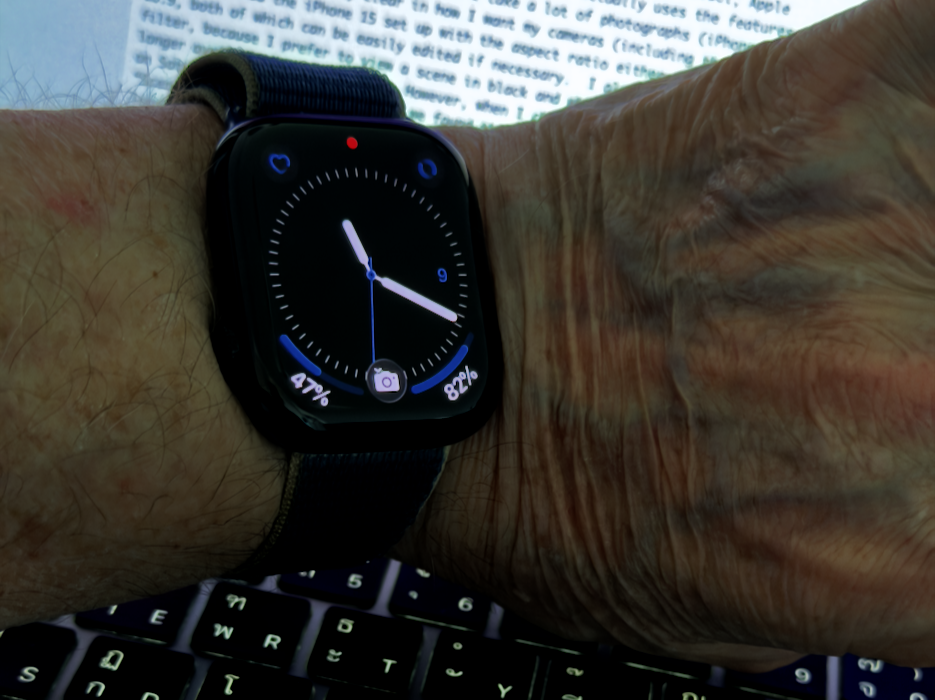
And yet, after a long lunchtime trip to the center of Bangkok, I returned and the charge showed 69%. I put it on charge immediately. Instead of the 80% option offered, I elected to have the watch charged fully. Less than 45 minutes later, it was done, which was quite favorable compared to the previous days' experiences. Overnight (Saturday) the charge dropped from 98% to 48%: much more than with my previous watches. Maybe I have missed something in the settings, but the improved battery does not seem to be working for me.
I tend to ignore most rumors, particularly from a couple of specific sources that other technical sites repeat almost verbatim. Once in a while, however, there is something that is worth considering. Ming-Chi Kuo is one of those rumor-pushers whom I tend to dismiss much of the time, but this week, he suggests that Apple could be looking to use Intel again for some of its M-series chips. Among others, Ryan Christoffel (9to5Mac) looks at this idea and suggests there could be some positives to this, although he does not mention the point that TSMC is using 2 or 3nm processes for chips now, and Intel may not have those capabilities. This would certainly be good for Apple with the idea of diversification, and would also please the current US administration, while providing a life-line to Intel.

This week I taught a group of graduate students from China. They were all in a computer engineering program, and I was asked to talk to them about my views on AI. My skills are focused on writing, although from talking to members of the Computer Engineering department here, they are just as concerned as me regarding the output from their students, and the reduced skills they will have if all their code is produced automatically.
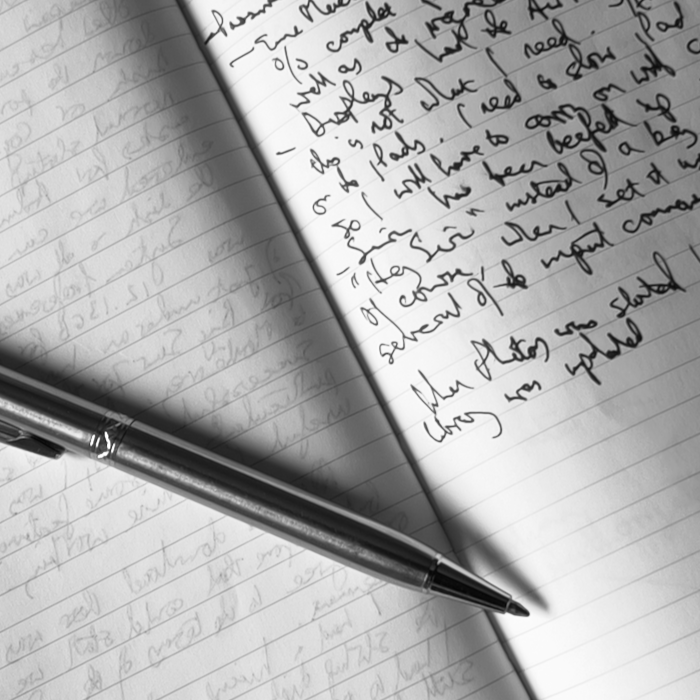 In my talk I outlined the basics of my writing process, which starts with pen on paper, then goes into a text editor (ASCII text - unformatted) on the Mac where changes are made during the typing. After further checks, I will produce formatted text. If I need to write a document I use Pages and usually export a .docx file. If the content is to be used on the web, I will markup with HTML using the same text editor (BBEdit).
Each medium change (hand-written, ASCII, formatted) allows me to look at the content in a different way and helps me spot ways to improve the text. I also leave the final version for a while: a couple of hours at minimum (a day or two is better). Looking at it afresh, shows me ways to improve what I had written. From time to time in the class I tried to link the idea of writing to producing code. I was heartened while expressing my concerns, when one student put forward the idea that they need to take the code they have and check carefully before use: trust but verify.
My comments on AI followed a history of technology, from the pyramids, through the slide rule, then the transistor (1947) to the calculator and computers. Each step in technology, brings its own problems. As we are seeing with AI, there are several drawbacks and I pointed out some of the weaknesses I had found with the word salads I am asked to fix. I also looked at non-existent references (far too common) and the idea of Hallucinations, although I had to explain that word to the group. That may have been a language problem. As they are using AI, and studying it too, they may be unfamiliar with the word in English and may use a Mandarin word without reference to the English.
I had already mentioned the use of similar problems in my comments on AI, Writing and Risks and included there a couple of references to the related use of false AI sources in litigation. There have been far too many of these. Right on cue, another one of these appears this week from Cecilia Nowell (Guardian) who reports on a prosecutor at the Nevada county district attorney's office in northern California who "recently used artificial intelligence in preparing a filing, which resulted in an inaccurate citation". It also looks like the same prosecutors office has used AI in filings before. The District Attorney said, "all of the attorneys in the office were reminded to verify all legal citations independently and not rely on AI-generated material without confirmation from reliable sources". Don't trust. Verify.
The ethics of using AI in academic writing disturb me. That also applies to photography, and an interesting point occurred when I was trying to explain this to the group of Chinese students using my film cameras and the Nikon D850. There was audible surprise when I brought the Hasselblad out of my bag, and then the Rolleiflex I have. Later some of the students held the Hasselblad as I explained some of the special features. It was nice to feel the way students immersed in modern technology can still connect with older ideas.

That point about ethics has come to the fore with more news regarding the withdrawal of the AppleTV series, The Hunt that happened silently a week or so ago. It is reported by several sources, including Zac Hall (9to5Mac) that the reason is suspected plagiarism, with the screenplay having more than a passing resemblance to a novel from 1973, La Traqué . The screenwriter Cédric Anger is accused of ripping off the novel without acknowledging the adaptation. The final sentences tells us that Apple and Gaumont (the film company) may well sue Anger. They would have invested a lot of money in the production and that could now be lost.
There are a number of books with the title, La Traqué, but the 1973 French book in question was originally written by Douglas Fairbairn in English with the title Shoot. It was published in 1973 and was made into a movie (Shoot) released in 1976. This is a bed of thorns and Apple is right to pull out of this, although they (and especially Gaumont) might have done some research before. I expect the release of the trailer set alarm bells ringing. Let's see: American author, French translator, French publication, French film company, and American conglomerate. The courts may well be busy.
On Netflix, after finishing the exceptional The Beast in Me I was left slightly adrift, then I noticed Mr Mercedes, which is not a new series (2017-19), but has recently arrived on this service. Brendan Gleeson is always worth a look, and in this he is a disgruntled, retired police detective in self-destruct mode with a monkey on his back that he cannot shake off: the murder of several people by a psychopath driving a stolen Mercedes-Benz. The murderer keeps messaging him and the torment makes for good TV potential. The opening scenes are riveting, bloody. Horrific.
This week the final series of Stranger Things arrives on Netflix and this has apparently moved to 1987, which helps the problem of teenagers becoming older. The actors can play the parts as they are. I have only watched the first episode of the final series so far and that seemed to be set in the former time. There has been some pre-publicity and the Duffer brothers suggest that, at least, we should refer to certain earlier episodes to help with the context of what is to come. Jack Seale (Guardian) is clearly enthusiastic and claims that at the end of the first group of 4 episodes, we have "a solidly thrilling 90 minutes of flame-throwing, bullet-dodging spectacle . . . which culminates in a moment that will have fans standing on their chairs and hollering joyfully." I am obviously looking forward to this. The next 3 episodes are available on 25 December, then a final, final one on 31 December, However, Mariella Moon (Engadget) reports that thousands of viewers were cut off when Netflix crashed just as the streaming began. This happened even though the service had increased its bandwidth by 30%. I had no such problems here when I watched.
As soon as it arrived this week on AppleTV, I watched The Family Plan 2 which was entertaining, but like Nobody 2, lacked some of the spontaneity of the original. In both, the action sequences seem to have been lengthened, while the more whimsical sections, in which the audience learns more about the characters were almost non-existent. The movies both lacked depth: 2 dimensional. Action over development.
The surprise Vince Gilligan production, Pluribus was pushed out early this week on AppleTV with this being Thanksgiving in the USA, and following the end of the most recent series of The Morning Show. I did not have my speculated, surprise reappearance of Mitch Kessler, and Stella was only mentioned in passing. There is always the next season, I suppose. Pluribus on the other hand was full of surprises and a cliff-hanger ending. With Carol Sturka seeing a new tactic from the friendlies: they left Albuquerque en masse after her aggressive approach, leaving her with pre-recorded messages and a drone delivery service.
She found, while trying to dump trash, that the friendlies drink a lot of milk. Intrigued she investigated and discovered that it is not milk but a liquid made from an unidentifiable powder. Indirectly, using barcodes, she tracked it down to a factory where in the final scene she entered a cold room. This was packed with food. While looking round she saw other items under covers and drew them back. In a lovely take, she looks, focuses, then has a horrible realization about what she has just seen. Cut. I speculate that this has all the weight of a Soylent Green moment.
Graham K. Rogers teaches at the Faculty of Engineering, Mahidol University in Thailand. He wrote in the Bangkok Post, Database supplement on IT subjects. For the last seven years of Database he wrote a column on Apple and Macs. After 3 years writing a column in the Life supplement, he is now no longer associated with the Bangkok Post. He can be followed on X (@extensions_th). The RSS feed for the articles is http://www.extensions.in.th/ext_link.xml - copy and paste into your feed reader. No AI was used in writing this item.

For further information, e-mail to
Back to
eXtensions
Back to
Home Page