
5 October 2026
By Graham K. Rogers
I am still discovering changes in the OS 27 updates: some good, but still some missing ideas. A Texas school district finds iPads and the MacBook Neo a better fit than Chromebooks. My Hasselblad uses film magazines. The company makes a digital back that works with the older analog camera. I tried this briefly at the weekend. Wealth, does not mean someone has good ideas: the most visual (and vocal) may be walking us into disaster. Tired of US interference the government of the Netherlands intends to drop Windows and move to Linux, like France, Denmark, et al
I updated my devices last week to the various version of OS 27.0.1, but on the iPhone, I found that some of the apps crashed when opened. Or they opened and crashed after a few seconds. This did not affect all apps, but just enough for me to roll my eyes and suspect that along with the bug fixes, a new bug had been introduced. It was later found that Google - not Apple - was the culprit. Anurag Chawake (Cult of Mac) was one of several online sources who reported that it was due to "[a] glitch in Firebase, Google's backend platform that many software developers use for authentication, cloud storage and other features.
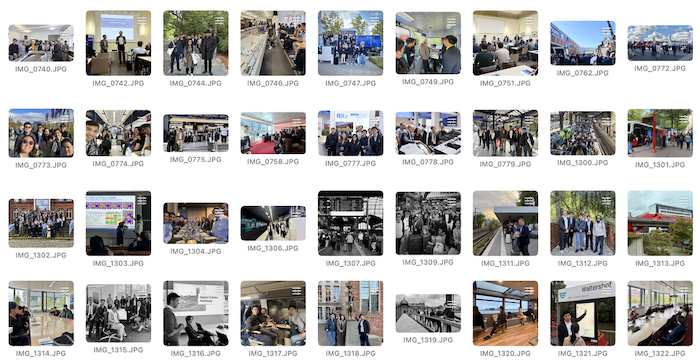
I am still examining the latest update to Apple's various OS versions. I am pleased to see some of the changes, but there is still so much missing. I have thousands of images in my Photos library and some are really just in the way. In Aperture (a long, long time ago) one useful feature, which is available in the Finder on macOS, was Stacks. In the Finder, I stack all PDFs on the desktop, all images, and all other files: 3 different piles. I can open them up with just one click. In Aperture, if there were several similar images, as might happen after a shoot, these could be stacked. This saves space. In my Photos library all images imported are shown. Not all are mine. Some - connected with a specific event, for example a student trip to Germany late last month - are sorted into a folder for ease of handling, but all images are still shown in the Library. To see images perhaps only a few days old, I have to scroll back past the event images. I would be able to save some visual space if stacks could be used, but this would have to be available in macOS, iPadOS, and iOS. It is the last of these where such saved screen space would be most useful.
I was just informed by Apple that the price of my Music subscription will increase from the end of October. I am currently paying ฿139 ($4.15), but this is to be increased to ฿149 ($4.45). I think I will be able to absorb that fairly easily.
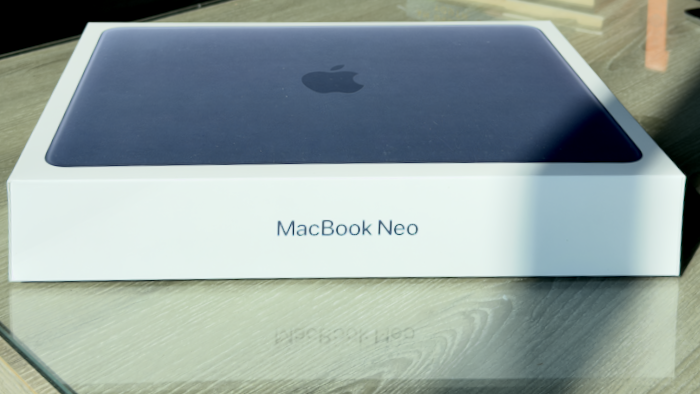
A school district in Texas has changed its education program from using the Chromebook to the iPad and MacBook Neo in a deal said to be worth $11.19 million. Reasons for the switch are "better reliability, lower costs, and performance." The "aging Chromebooks" were costing too much for repairs and maintenance. The deal with Apple includes some "4,000 iPads for students pre-K through second grade and 9,500 MacBook Neo units" plus 1,000 MacBook Neo devices for teachers. The district looked at Lenovo and Asus alternatives, but Apple reliability and the financing terms helped them make the choice.
Not mentioned in the article is the point that to use the Chromebook, there must be a login to Google, so the company is able to collect data from hundreds or thousands of young people (and their teachers). There is no guarantee about what happens to the students' data after it is collected.
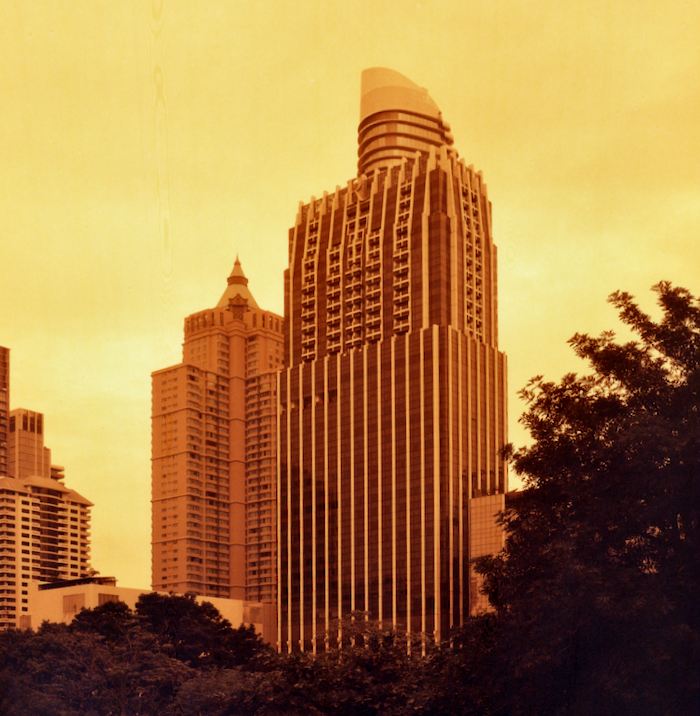
I am a regular user of film, especially 120 which in my Hasselblad 500/cm produces images of 6 x 6. The negatives are far larger than 35mm (135) so there is latitude for cropping, which is sometimes necessary. I do have 35mm cameras, but I find that scanning the negatives is fussy. 35 mm films have 36 images on a roll. There used to be rolls of 24 frames, but I have not seen these for a while. My 120 films allow only 12 images per roll. I like to try a variety of film types. This week, for example, I had a roll of Kodak 100 and a roll of Harman Red developed. My go-to film is Ilford SFX 200. I like its sharp images and the good contrast. Zeb Andrews (PetaPixel) wrote about this a few days ago, and commented particularly on the way that using a red filter brings out the infrared capabilities of this product. Ilford make films with ISO as low as 50 and 80. I used the latter this weekend and the roll is in for developing now.

|
|
The Boston-based company CAT Labs also have a 80 ISO film: a black & white film which I have tried a number of times. This week they announced that this is back in stock with 120, 4 x 5 and 8 x 10. They also announced that they have a new black & white film: CatLABS X Pan 320: unfortunately only in 35 mm. I noticed on the site that they also do a color film: ISO 100, in 35 mm, 120 and 4 x 5. Another announcement was somewhat unusual: a batch of 220 film - like 120, but as it has no backing paper, can be made twice the length, which means 24 exposures for me. I have one suitable back for this. This selection of Fuji and Kodak films are all expired, but have been frozen since purchased. If they are not already in my bag, I keep my films in the fridge. A colleague at work has a freezer compartment in a fridge full of expired Fuji film.
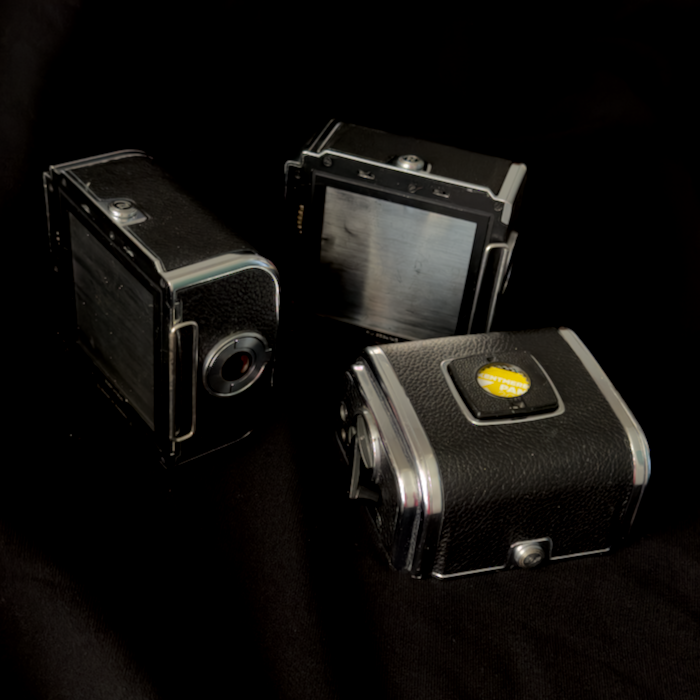
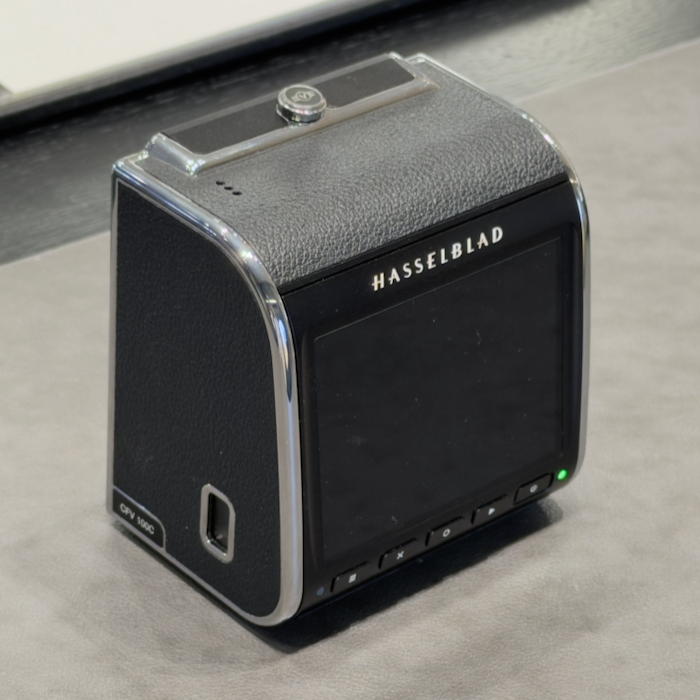
One of the attractions of the Hasselblad 500cm camera I use is the ability to swap film backs in the middle of things. If I am shooting in black and white, I could (if I had a loaded film back) switch to color, or a different type of black and white, say from ISO 50 to ISO 400, depending on conditions. These days I could also switch to a digital back, with a 100 MP sensor, if I were able to afford it. One never knows. I had a look this weekend. The staff in the Hasselblad/DJI store in Siam Paragon were helful and quite willing to let me try this out, even letting me walk out of the store to try in different light conditions.
|
|
Just slotting the device on to the back of the film camera could not give me a full test and there is a learning curve. For example I was slightly surprised to find I had to use the film winder after taking a shot, for the shutter to be ready for the next one. I am not sure how much, if at all, changing settings on the lens (apart from focus) affected the input. I expect time and aperture settings would have to be changed on the digital back. Like many digital cameras there is a host of settings on the device that would help me improve the output, but in the short time I had, I was still suitably impressed. Clip it on and it just worked. The member of staff sent me a link for access to the images.
I figuratively held my nose while I downloaded a few of the JPGs from Google Drive. The RAW images were just too large at about 200MB each. This had already given me some concern when I had been considering the CFV 100C digital back which is definitely on my wishlist. I was told in the shop that the CFV 50C was no longer available (or not here) so image management would be of concern, as mentioned in online comments recently (Raf Lopes, PetaPixel). The JPGs I was sent were in the region of 35 MB each so gave me a fair idea of output. I usually work in RAW and PNG for digital files, or TIFF for scanned images.
I do not often write about politics in this forum, nor do I include expletives, but as I read a headline on Wednesday morning, I let slip an involuntary, "O f**k". Nick Robbins-Early (Guardian) reports that Pete Hegseth, the Secretary for War has appointed Elon Musk to a "government project to study the future of warfare". The committee will look at how the US military could "achieve absolute technological dominance on the next-generation battlefield" and one wonders, what could go wrong? Hegseth has also recruited Palmer Luckey, CEO of the defense tech company Anduril, and Newt Gingrich, the former Republican speaker of the House. Gingrich had a lot of input on this in the 1990s, and was particularly influenced by the ideas of Alvin Toffler (Future Shock, et al) - Information is the new power.
Also commenting on this, Anna Washenko (Engadget) brings in Gingrich almost as an afterthought, noting that "Gingrich has no obvious ties to the tech sector" although his previous government experience and ideas on technology might well be a brake on the excessiveness of others. I must admit it is hard to think of Newt Gingrich as a tempering factor or braking force, but that may illustrate the size of the problem.
A wider problem is not simply the input(s) of Elon Musk, although in the eyes of many that is problem enough, but the way society, politicians and the media are so willing to listen to wealthy men, precisely because they are wealthy (and all men). When one actually listens to the troubling garbage that spills from their mouths, this demands some careful analysis. They think they know what is best for us and everyone else is wrong. They are often dishonestly airing ideas on what is best for their companies. We listen to Musk because he is so widely reported ("approval of what is approved of" - Betjeman), but when one listens to others like Altman, Karp, Thiel, and Zuckerberg, the wild ideas that are reported, precisely because these people are considered worthy, often have me worried.
It is not just the ideas. Because these men have control of some of the largest companies, some of which are specifically linked to AI, many just accept the advance of this use of technology as inevitable. I wanted to include Bill Gates in that short list, as he was often the go-to man for views on technology, but to be fair, Gates seems to have mellowed in recent years and has suggested applying the brakes when it comes to AI. Today (5 Oct) it is widely reported that Sam Altman thinks that the world should accept some bad things for the benefits of AI (Christine Mui & Brendan Bordelon, Business Insider). In an interview for Decoded, He said that he believes that "the technology's benefits justify accepting some risks". Will no one draw a line?
As an example of what I am concerned about, Alex Karp was recently interviewed in the street by CNN and what he says, and how he says it, are both as disturbing. A longer interview organized by the New York Times that I saw some time ago, is a far clearer demonstration of why (as the YouTube caption suggests), "Palantir is the most dangerous company on earth". As a clue to his personality, watch his feet.
A techno-political problem has appeared as the Netherlands appears about to join other nations in moving away from reliance on Microsoft Windows to a FOSS-based system: Free and open-source software. The government plans to switch its computers to Linux in its move to DAWO (Digitaal Autonome Werkomgeving Overheid) or Digital Autonomous Government Work Environment (Simon Batt, XDA Developers). The decision follows similar moves by governments in other European countries who trust US systems far less than in the past for some reason. The Dutch decision stems from when the "US government imposed targeted sanctions on the International Criminal Court (ICC) in The Hague. Microsoft, for example, cut off the chief prosecutor from the company's services". Such interference in independent bodies like this do not bode well for the rest of us: upset the USA and perhaps lose access to accounts and data. Holland would be particularly sensitive to any interference in operations at The Hague. Comments with the article note that Linux is somewhat more sophisticated than it was in its early days.
There are also a number of alternatives what some regard as essential software. I have never used Windows of course, coincidentally switching from MS-DOS to Apple at about the time Windows 3 arrived. There was a rather good version of Microsoft Word on my first (used) Mac, but I no longer have that and work quite well with alternatives on the Mac. My simple spreadsheet needs are covered by Numbers, and Keynote has been more than enough compared to PowerPoint. There is also Open Office, and there are other alternatives. I have several image editing applications, and avoid Adobe like the plague. There is the Open Source, GIMP, but Mac and iPad/iOS apps like Pixelmator or Affinity Photo have plenty of muscle if I want more than a basic edit. There is also the highly regarded Graphic Converter.
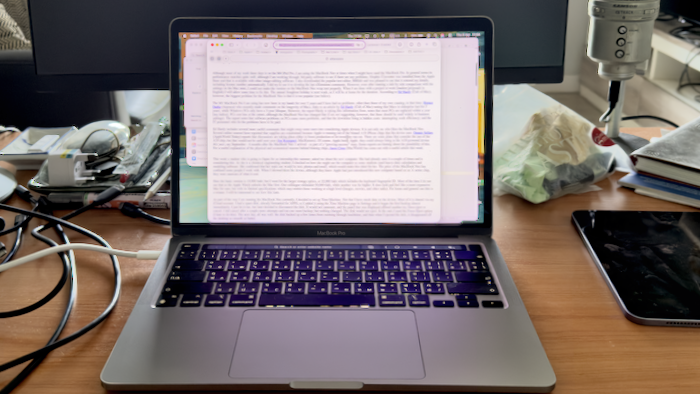
While I was preparing this, I saw a brief note on AppleInsider by Mike Wuerthele in which he reports that developer Sven Peter is beginning development of an installation of Asahi Linux on the M4 chip and the MacBook Neo. There is more on this in an item, by Michael Larabel on Phoronix. He explains that "[T]he initial Device Trees for Apple Macs. . . will debut in Linux 7.4" but this may not provide a usable installation at this early stage. It appears that initially the MacBook Neo may not be usable other than as a way to encourage future development.
Wikipedia shows a comprehensive list of LINUX distributions, but its sheer size is a bit overwhelming, although it is worth a look. Easier is a shorter overview of some of the major free, donate, and pay versions on DistroWatch. Even so, the list still leaves me unsure of which I might consider should I experiment, although I did cut the 11 down to a slightly more manageable 8, perhaps favoring Ubuntu, Slackware and Debian most. Like the Hasselblad CFV 100C digital back, this is tempting, but would I? . . .
Graham K. Rogers teaches at the Faculty of Engineering, Mahidol University in Thailand. He wrote in the Bangkok Post, Database supplement on IT subjects. For the last seven years of Database he wrote a column on Apple and Macs. After 3 years writing a column in the Life supplement, he is now no longer associated with the Bangkok Post. He can be followed on X (@extensions_th). The RSS feed for the articles is http://www.extensions.in.th/ext_link.xml - copy and paste into your feed reader. No AI was used in writing this item.

For further information, e-mail to
Back to eXtensions
Back to Home Page