
22 September 2026
By Graham K. Rogers
The iPhone Duo makes an impression on many, including Samsung. Major updates to Apple's operating systems with several new features including long overdue keywords in Photos on iPad and iPhone. Some potential changes to Apple services and devices confirm a new CEO is in the chair. 19 years of the iPod touch and the changes it wrought behind the scenes. AI steals information, then charges users high prices for its use.
The iPhone Duo has created much interest since it was announced. Some noted that the form factor (at least when opened) was similar to the iPad mini. Apple always has devices that overlap. Here however, although the screen size is almost the same, the price is not, so it looks to me as if there is little chance of cannibalism - where sales of one product affect sales of another. That might happen in some cases, such as the MacBook Neo and the MacBook Air although, despite the capabilities of the newer device, the two are not really in the same league. The iPad Pro, particularly when paired with the Magic Keyboard has some of the features of the MacBooks, but the different operating systems and apps mean that tasks are not done in the same way at all. I find that some tasks still need the Mac.
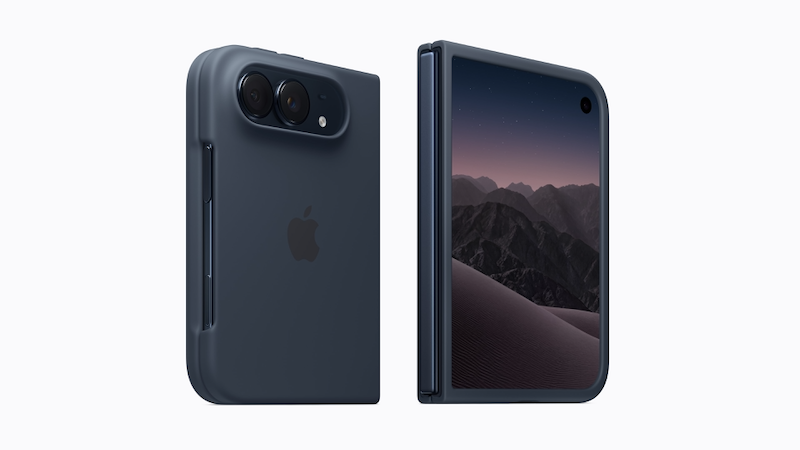
Craig Federighi was asked about this overlap in a YouTube interview and admitted that the same tasks might be possible using an iPhone and an iPad mini (William Gallagher, AppleInsider). He said that "this was another case where Apple's devices find their use cases". To me that suggests that it depends on the user and how the individual chooses to work.
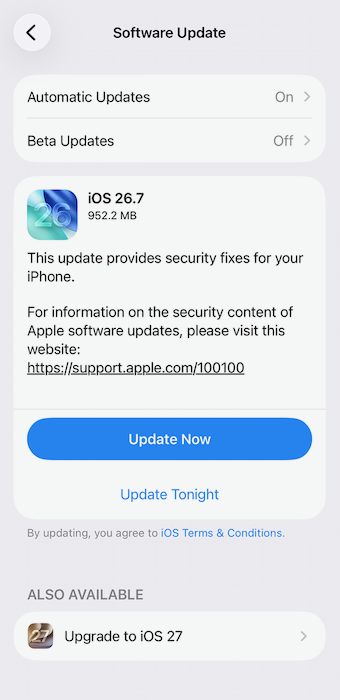
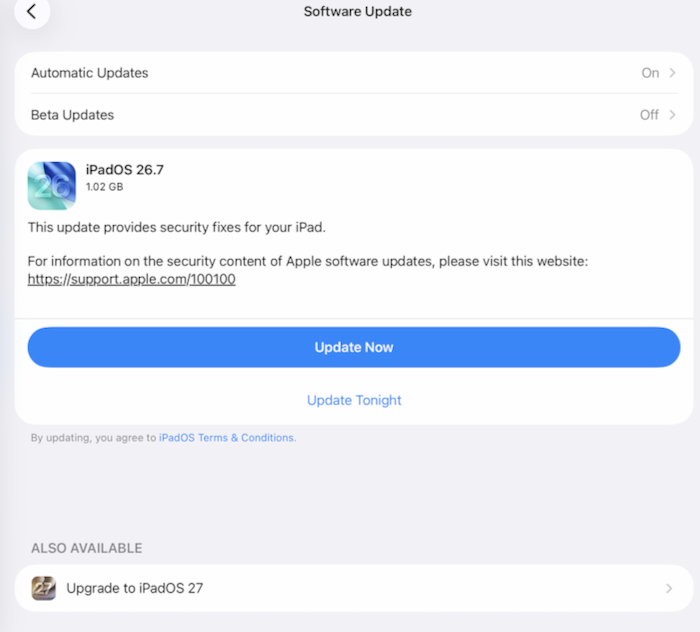
The new versions of Apple's operating systems became available early last Tuesday morning. I started the process by ensuring that all of my devices had been backed up. With the Mac I made a couple of extra backups before updating and made more (each on separate disks - redundancy is good) after Golden Gate had been installed. The download and update process went smoothly. IOS and iPadOS updates were less easy. Initially, the time taken for the Settings app to recognise that there was an update took a long time. This makes me nervous and reminds me of one iPad Pro update that was never found by the app. I had to wait for the x.x.1 version before the new OS arrived that time. When the download did appear on the phone last week, I pressed Install right away without noticing that this was not iOS 27 but a further update to iOS 26. The iOS 27 update link was right at the bottom of the screen, marked as Also Available. I did the same on the iPad mini. I am not at my best early mornings.
|
|
|
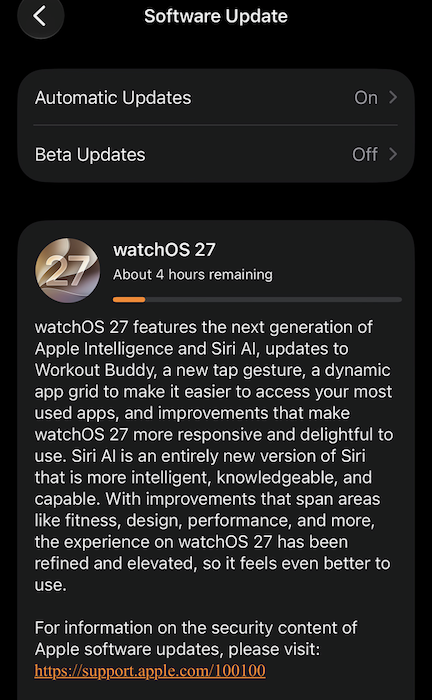
When I tried to update the Apple Watch, I was told I needed to update to the latest version of iOS first. It was only then that I saw what I had done. And not for the first time. I tried to install iOS 27 but it was slow to appear, and the download was glacial. In the meantime, the iPad mini update to iPad OS went fairly quickly. The iPad Pro, which was less than a metre away from its smaller sister, took an age, with the progress bar up and down between a few minutes and an hour several times. Eventually, my primary devices, plus the iPad mini, were updated. I was unsure if Golden Gate would be available for the MacBook Neo as I had been running the public beta and had downloaded the final version. I turned the beta access off on Wednesday, and when I checked, Software Update showed that the MacBook Neo was up to date. Fair enough.
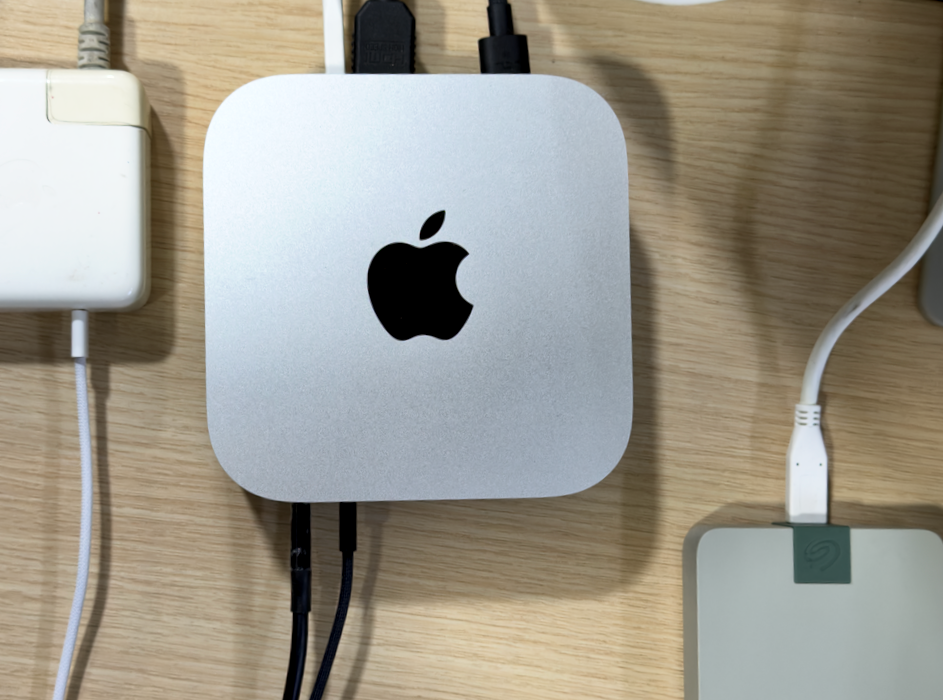
After a Time Machine backup, the M4 Mac mini in my office showed the macOS 27 update was ready to be installed although the 27.23 GB download took a long time over the university link: about 7 seconds for 0.01 GB. That would be 5+ hours at that rate, although the progress bar showed 4 hours. It was completed just after lunch. Patience. I usually go home if I need to do any serious work on the internet. All that was left was the Apple Watch and the download arrived at its usual slow pace. As I had half-expected, the Apple TV would not accept version 27. I was told that 26 is it. Now I have to wait until Apple releases a new TV box, and for its arrival in Thailand. For now I will carry on as usual.
There is a lot to take in with the new updates. The new features and other changes will take a while for some to learn. To help, MacRumors produced a guide to iOS 27 that was put together using the beta versions. Juli Clover outlines some 44 changes, including to the Weather app. I had a look immediately, and this looks much better, particularly the 10-day view (rain, rain and rain here, unfortunately) and the Conditions section, which may help my dash for the taxi before the rain each afternoon. This "MegaGuide" will take a while to work through, but I am grateful that MacRumors made the effort to produce this. I also note that, although the iPhone was fully charged when I began the updates, by mid-morning it was down to 65% as the iPhone adapted to the new OS version. It returned to normal within a day or so.
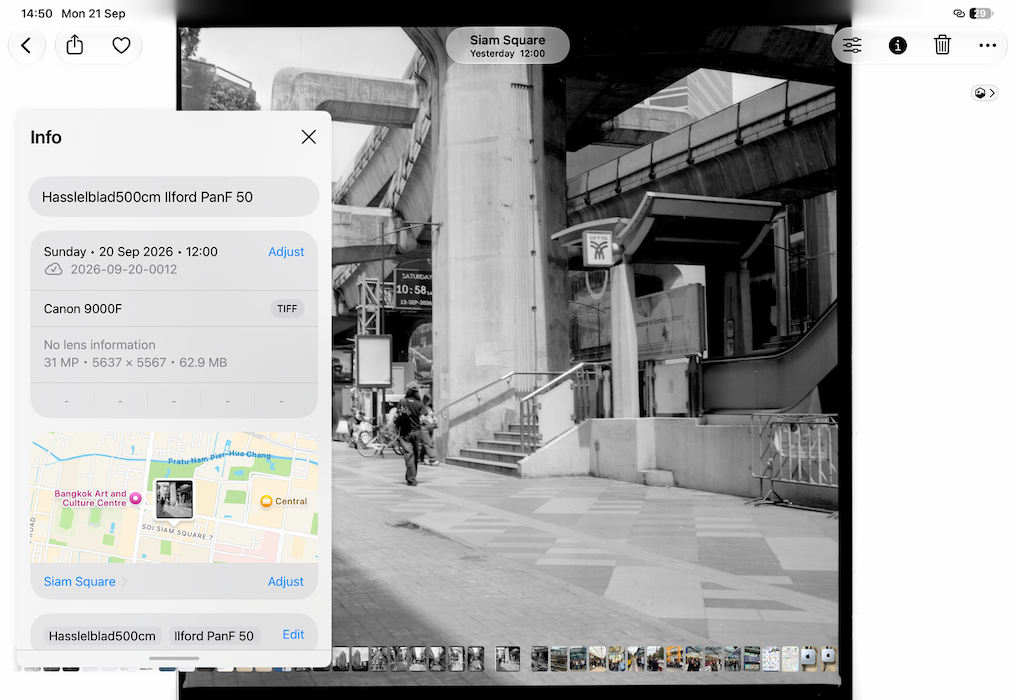
I was also pleased to find that, in iOS 27, at long last, it is possible to add (and then see) keywords to photographs in the Information panel (Ankur Thakur, iDownload Blog). I had been frustrated by this as I do a lot of work on the iPad and iPhone with my photographs and often wanted to include keywords. I could only do that on the Mac. This has taken too long to appear.
Each word or phrase entered must be checked individually (or press Enter), then once all keywords are entered, they are accepted. On the Information panel now, these are shown at the bottom, under the location. It is not possible to copy these and paste them into the metadata of another image, although it is on the Mac. Also on the Mac I usually make a batch entry of image information. Again, batch entries are not available on the iPad or iPhone. A small step has been taken nonetheless. I made suggestions as to copying and batch entries on the Apple Feedback page.
Firmware for AirPods was updated last week. Juli Clover (MacRumors) reports that "The firmware has a build number of 9A348." A related article on these updates by Ed Hardy (Cult of Mac) includes a number of related details including how to see the firmware number for the device and how to force an update. Mine were still showing 8B39, so I plugged them in when I went home and they had been updated within a short while.
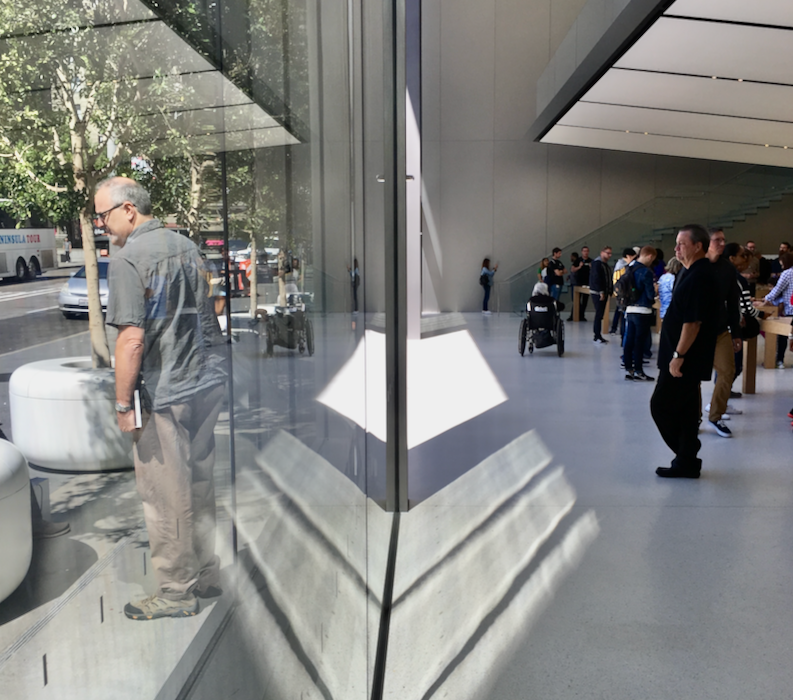
A couple of changes have been suggested which may be the new CEO, John Ternus, putting his stamp on the company, as he should. Vision Pro is not finished by any means, for example. During Tim Cook's reign, the Apple Store Genius Bar was changed to a Genius Grove: pleasant trees and low seats.
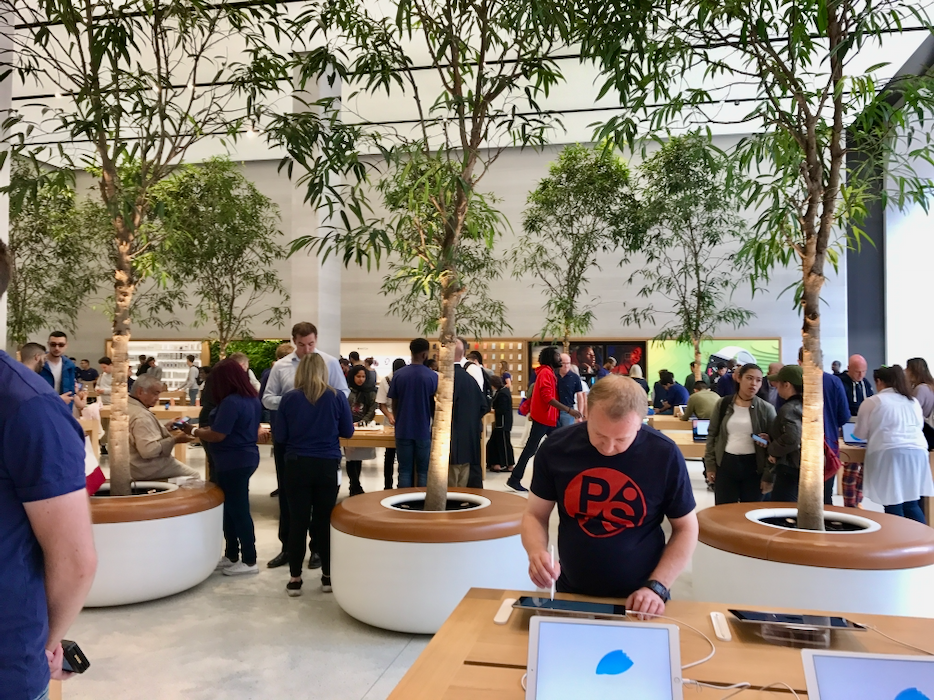
There are rumors that suggest the Genius Bar is to return (Mike Wuerthele and Malcolm Owen, AppleInsider), although whenever I have wanted help in the Bangkok Apple Stores those high wooden tables have been quite comfortable as a working area.
Several years ago, Apple used to make a beautifully-designed range of servers. There was also a separate version of OS X. The Xserve which was sold between March 2003 and January 2011, originally had G4 PowerPC chips, then the G5, and finally Intel Xeon. For quite a while the Mac mini has been used in server racks, and I expect that the more powerful Mac Studio has been used as a server by some. But, what if. . . what if the new CEO, who is a hardware man at core, had been thinking about renewing the line of Apple servers, particularly with the recent rush for powerful devices? Mike Wuerthele (AppleInsider), whose article features the insides of a G5 Xserve, suggests that Cupertino has been thinking about such a device that would use M8 Apple silicon and NVidia NVLink Fusion. This could be a while in reaching fruition, but good ideas have to start somewhere.
There have been some changes to Apple Cloud. Benjamin Mayo (9to5Mac) reports that in several countries Apple is now bundling AppleTV and Apple Arcade with Apple Cloud +. But not here. Neither Cambodia, Indonesia, Myanmar, Philippines,Thailand, nor Vietnam are listed. The closest are Bhutan and Nepal.
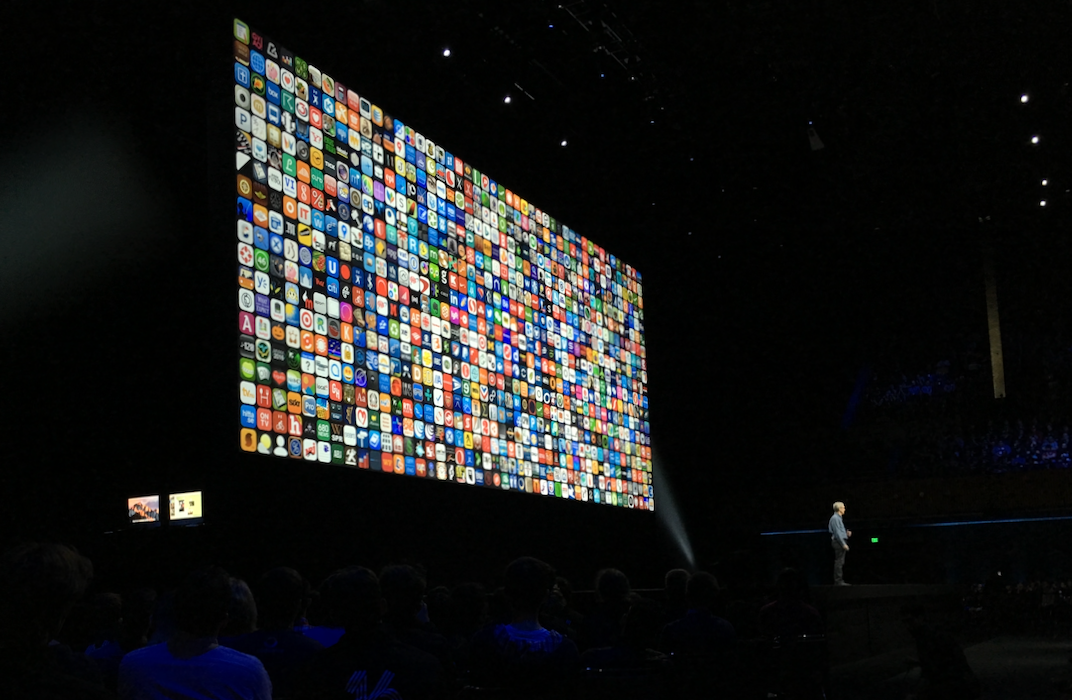
Apple's current event format was forced on the company by Covid. Travel was restricted, the idea of having hundreds of people in a closed environment, with most of those attending staying in hotels, was a recipe for epidemiological disaster. The open air nature of the new Apple HQ also played into this limiting contact; and within the company environment, small units of people who were clear of any infection were able to put together some stunning videos for product releases and explanations. As a side-effect, not having to pay for transportation and accommodation for hundreds of journalists would have saved Apple millions of dollars too. I accidentally saw the flight cost of my ticket from Bangkok to San Francisco once and that was not coach class (all that I can normally afford). Add to that the limousine to and from the airport; hotel for at least a couple of days (the first time I went in 2007 I was in San Francisco for 6 days); and travel to special events, although sometimes it was good to walk. That all adds up so the video format makes sense.
In recent years, Apple has taken to inviting journalists and developers to live presentations again, although numbers seem to be limited. Just before I watched the event on Apple TV on Thursday afternoon, I had seen the live introduction of the iPhone Duo by John Ternus - "one more thing" - who was filmed onstage, facing an enthusiastic audience. I was disappointed not to see anything like this in the televised transmission. The presentations by Ternus and others were prerecorded and lost some of that spontaneity that the stage presentations have, although the detail in the presentation of Johny Srouji was probably best done prerecorded. Watching Jobs, Federighi, Schiller, and Tim Cook live, makes a connection with the audience, even if it is viewed later on YouTube.
One of the films I remember clearly from the 1960s was the wartime story of Eddy Chapman, starring Christopher Plummer: Triple Cross. The title is a play on words as he had been awarded the Iron Cross by the Germans, while also working for British intelligence services. I had met Chapman a number of times at his country house near Shenley (now a school), just outside London, one of a number of interesting characters my father knew. I am not sure why he visited the former safe-cracker so often, although it was a well-known late night drinking haunt not far from the Elstree studios. Chapman always spoke gently to me and gave me a copy of his (perhaps part-autobiographical) book, Joey Boy, but he was still involved in a number of dubious activities (Bretherton Law).
The film title (and the memory) popped into my head when I heard that Samsung are hard at work developing a triple fold phone. I am still doubtful whether there is a need for any folding device, although I am quite impressed by the way Apple has tried to engineer its way out of the crease problem that has afflicted Samsung's devices. To try and engage in a pissing context with a second fold, and apparently rushing the release is asking for trouble (Ben Lovejoy, 9to5Mac).
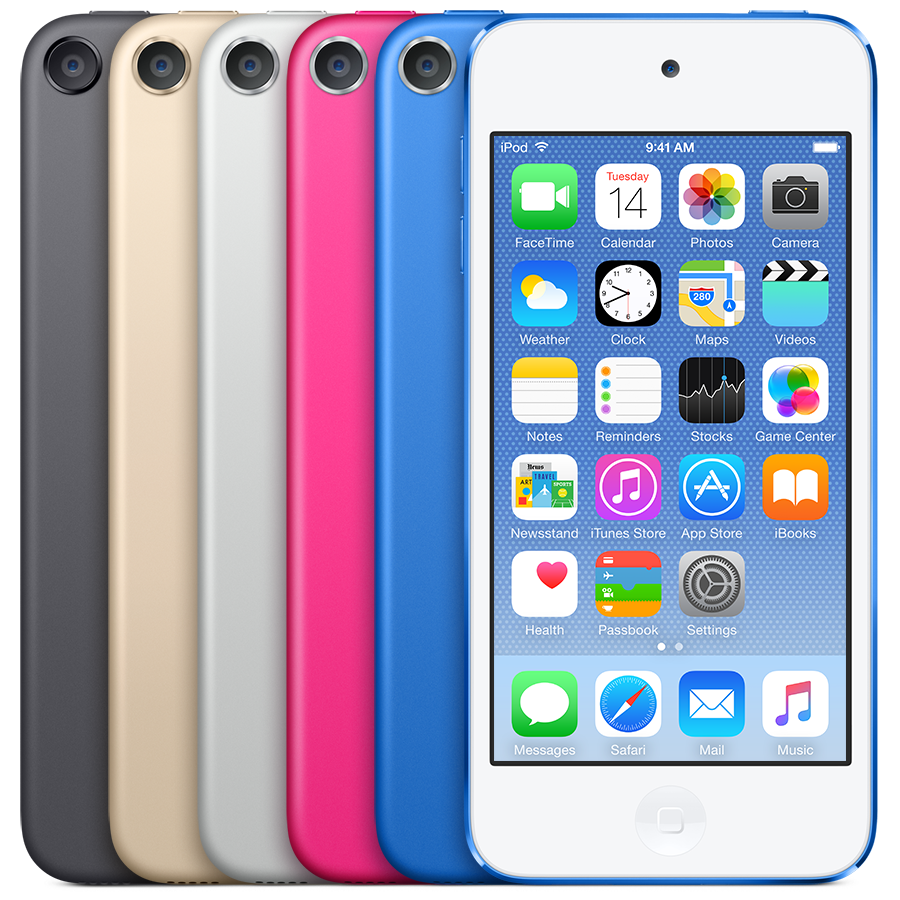
We were reminded this week that the iPod touch was released 19 years ago this week (Tim Hardwick, MacRumors). Owing to early limitations, this was the closest then anyone in Thailand was likely to be to the iPhone-like format. The iPhone 3G was announced in 2008. When True put this on sale in a large event in Siam Paragon, it was the first time the device was made official. At the time, Apple did not really have a large presence here, but it was just being expanded. They were however happy to fly people like me halfway round the world for their launches.
The year the MacBook Air launched (2008) I was invited to MacWorld again. As well as the new Mac, Steve Jobs announced the iPod touch 2, adding that those with the original version could just update the OS and that would be the same. I spent the next couple of days looking for the new device (Cupertino, San Francisco) with no luck, but in the Union Square Apple store I met the head of Apple in Thailand who promised that one would be made available when they arrived in Thailand. I was invited to a store in Fortune Town a couple of months later and bought my iPod touch.
A problem for me at that MacWorld was that it was not possible for those in Thailand to download the update as there was no iTunes store here. I was told that this had been discussed, but Marketing were firm that the iTunes Store was the way forward. It makes sense now. In a discussion with an Apple director at a dinner, I put forward the idea of a 2-level store: music and videos were copyright, so were not available then; but Apple distributed the apps, so could control their online sale, plus they would be able to collect user data. The director told me he would pass the idea on. In June the App Store opened and those in Thailand were able to buy apps. I am sure they had been planning this for a while, but great minds think alike.
I was somewhat taken aback by a headline of a Tom's Hardware article by Jowi Morales, which in part reads, "Microsoft director called AI scraping 'the largest theft of labor in human history,'" This was after I had written the words below. To put the title in context, this was part of an internal memo (dated 2023) that was cited in a legal case between the New York Times against OpenAI and Microsoft.
Every so often there is a leap in the number of hits on the eXtensions site. When I saw a higher figure for the number of hits in the previous 24 hours, I had some hopes that the content I had just put online had had a good number of readers. When I looked at the statistics that did not appear to have been the case. A further examination of the stats shows that one IP number had eaten a fair amount of data: 74.7.241.9. I dug out the Network Utility app on the Mac and had a look. The Ripe DNS server revealed this as "Microsoft Routing, Peering, and DNS". And I guess, copying the data for use in AI.
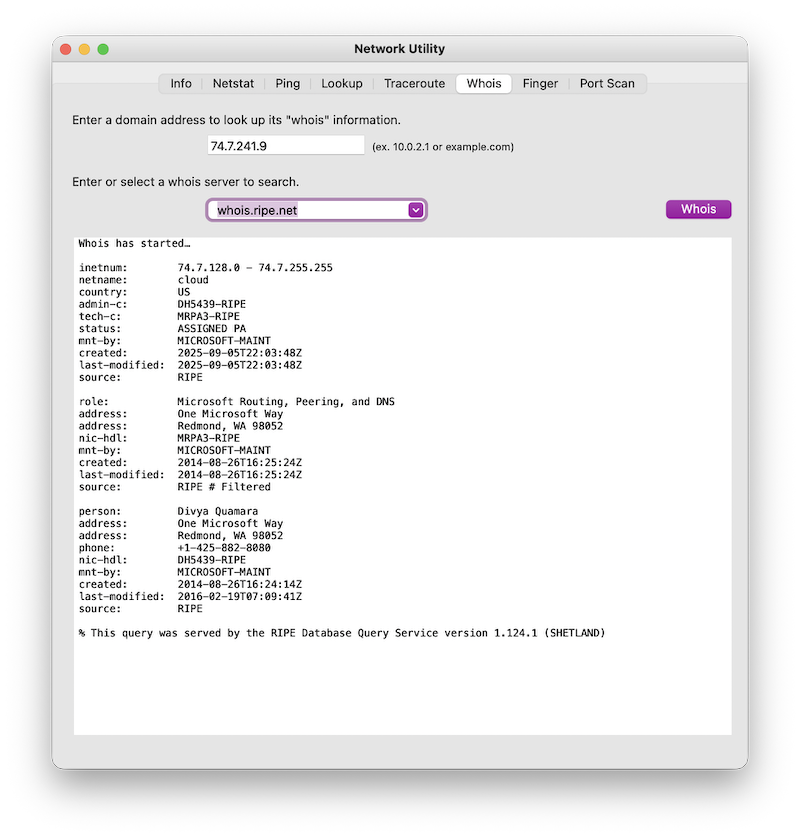
I should send these guys a bill. And all the others who steal my data. I am happy enough for anyone to read the information, but it is copyright; and if (as happens sometimes) the text is used, to provide a link (as I do when I link to other sites); but that is a forlorn hope. AI steals the content that it then sends to users who are required to pay for it. AI companies argue that scraping the internet for data to feed to their models is "fair use," yet charge the users of their LLMs huge sums to provide the answers users are too lazy to work out for themselves.
Graham K. Rogers teaches at the Faculty of Engineering, Mahidol University in Thailand. He wrote in the Bangkok Post, Database supplement on IT subjects. For the last seven years of Database he wrote a column on Apple and Macs. After 3 years writing a column in the Life supplement, he is now no longer associated with the Bangkok Post. He can be followed on X (@extensions_th). The RSS feed for the articles is http://www.extensions.in.th/ext_link.xml - copy and paste into your feed reader. No AI was used in writing this item.

For further information, e-mail to
Back to eXtensions
Back to Home Page