
eXtensions - Friday 21 August 2026
By Graham K. Rogers
Updates to some current OS versions and to betas have been released. The latest developer betas hint at a raft of new Apple products. A probable release is a new AppleTV. As mine is one of the earlier versions, I am budgeting for the new device, when and if it arrives here. Anthropic tried to follow the EU requirements regarding AI watermarking, but may have dug itself into a hole. And Jill Lepore looks back at warnings that were ignored.
There were updates last week to iOS, iPadOS and macOS, bringing the versions to 26.2.1., and to 26.6.2. for the Mac. These updates are quite important as they address a number of vulnerabilities that have been identified, including one on the Mac that takes advantage of screen-sharing that "allows attackers to bypass Screen Sharing's login screen" (Anurag Chawake, Cult of Mac). That bug has been seen in the wild, so an update is advised.
It is reported that a record number of users in 110 countries received warnings from Apple about a spyware attack last weekend (Omar Marques, TechCrunch). I am pleased to say that I did not have one of these, and equally pleased that Apple does this. However, I did receive an email that purported to be from Apple telling me, in Thai only, that there were problems with payment for iCloud. This was a day or so after the payment had been made automatically. There was no warning from the credit card company, iCloud continued to work properly, and (from previous experience) when there are warnings about payment those are displayed in System Settings.
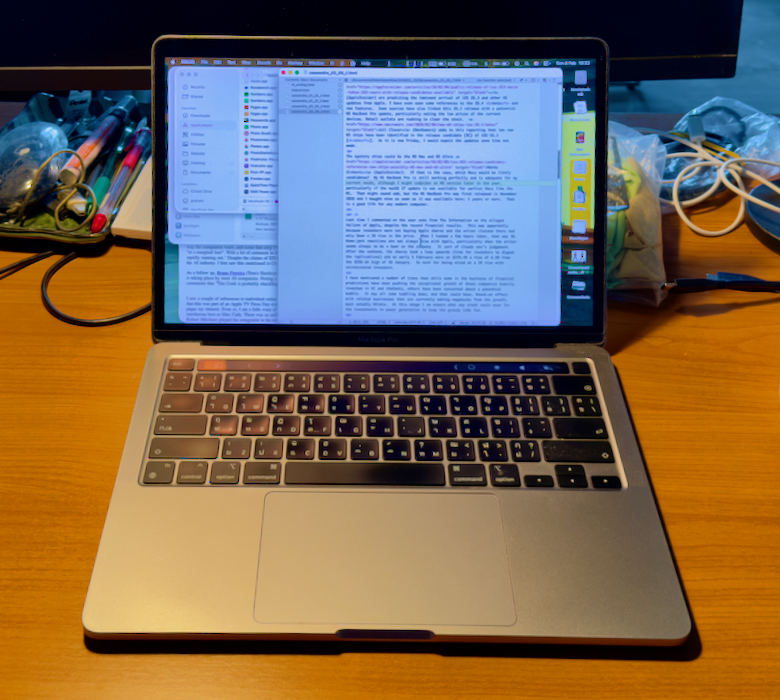
When I opened the email on the Mac later, I used the View menu to look at the raw code of the message. It had been sent from Japan, and there was no real indication that Apple had had any hand in this. I sent it to "reportphishing" at Apple and an automatic acknowledgment was sent back some time later. Usual warning: Apple does not send emails when there are problems. Never click on a link in an email. Be vigilant. I have not found a way to look inside emails on iOS devices, so always wait until I have the Mac before looking deeper. I start with a couple of basic checks: the return address, the address it was sent to (I have more than one email), and any IP numbers within the message. And the language. That is usually enough to show that the message is not genuine.
Apple also released a clutch of beta updates last week adding more this week, with the 6th versions now available. Developers always go digging in the code to see what new things Apple has put in and with the latest releases (not for the first time) there are mentions of new products. I installed the 3rd public beta of macOS Golden Gate on the MacBook Neo last week after a 3-week lull, and the 4th public beta arrived this week. Marcus Mendes (9to5Mac) outlined the third release, including the new icons, and mentions the new Siri app which I tried. I had to send a request to Apple for its activation, but the response was fairly swift. Antonio G. Di Benedetto (The Verge) has a look at this, although (like me) he does not appear to have been a regular user of this feature in the past. He gave Siri a workout, but there were some hits and misses. He expects that there are improvements to come.
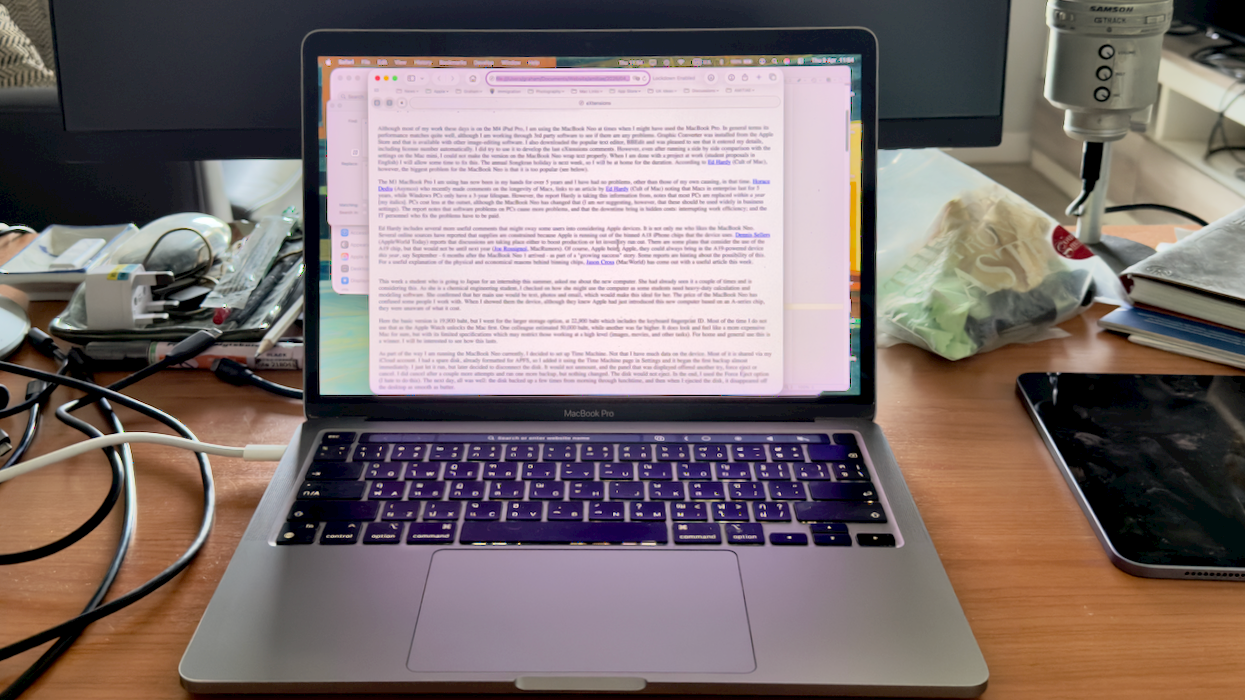
A review on AppleInsider was more positive, but the uncredited writer seems to have had far more experience with Siri in the past and notes that it is part of his daily workflow. From a photograph in the article of a MacBook Pro with a selfie, I think this is William Gallagher. The review notes that there are some failings. It appears to be quite different from the previous Siri. Both this review and earlier comments by Antonio G. Di Benedetto mention "asking" Siri, but this was not easy to find initially. Online information told me that it is now in Spotlight, and voice can be activated by holding down the Command key. Not that I managed that either.
I was unable to find any information about this before the AppleInsider comments and this did not work for me. Maybe I should have typed a question in Spotlight. However, I finally spotted a microphone icon at the bottom of the screen in the Siri app and that works, although it is all a bit long-winded on a Mac. The review has a long look at the related Shortcuts and the changes there. I note that this appears still to be using AppleScript, which used to be so simple even I could write an app. The review is worth reading as it appears clear that there is much potential here, but the execution eludes the writer's best intentions. At the end, there is a short list of Pros and Cons. Concise.
As the developer betas were analyzed, some unusual information was found. Apple usually keeps its cards close to its chest regarding new products, but code for at least 10 products were found. Added to that there was a video for the new AirPods, seeming to confirm that they have a camera. Rajesh Pandey (Cult of Mac) outlines the products that appear to be revealed. Unsurprisingly the iPhones are listed. There are 5 models, and Pandey suggests one of these could be the long-rumored foldable iPhone. This is most certainly not on my list. I do not understand why Apple would take this path that has already seen many casualties. The MacBook Pro models shown all have M6 chips, including a new 14" device. iMacs, also with the M6 are shown too. There should be a new iPad mini as well. The AirPods with the camera are now shown, although I would not expect them to arrive this year. Other devices that have not been identified are also listed.
It is widely expected that Apple will be releasing or announcing a number of new products in the near future in conjunction with the updates to OS 27 in its various forms. Always a good indicator, I have noticed prices of some devices have been reduced by some major outlets, such as Amazon and others. The M5 MacBook Pro is one of these with B&H reducing this (with 96W adapter) to $1,699 (Christine McKee, AppleInsider). I am not totally sold on the idea that an M6 or an M7 version will be immediately available.
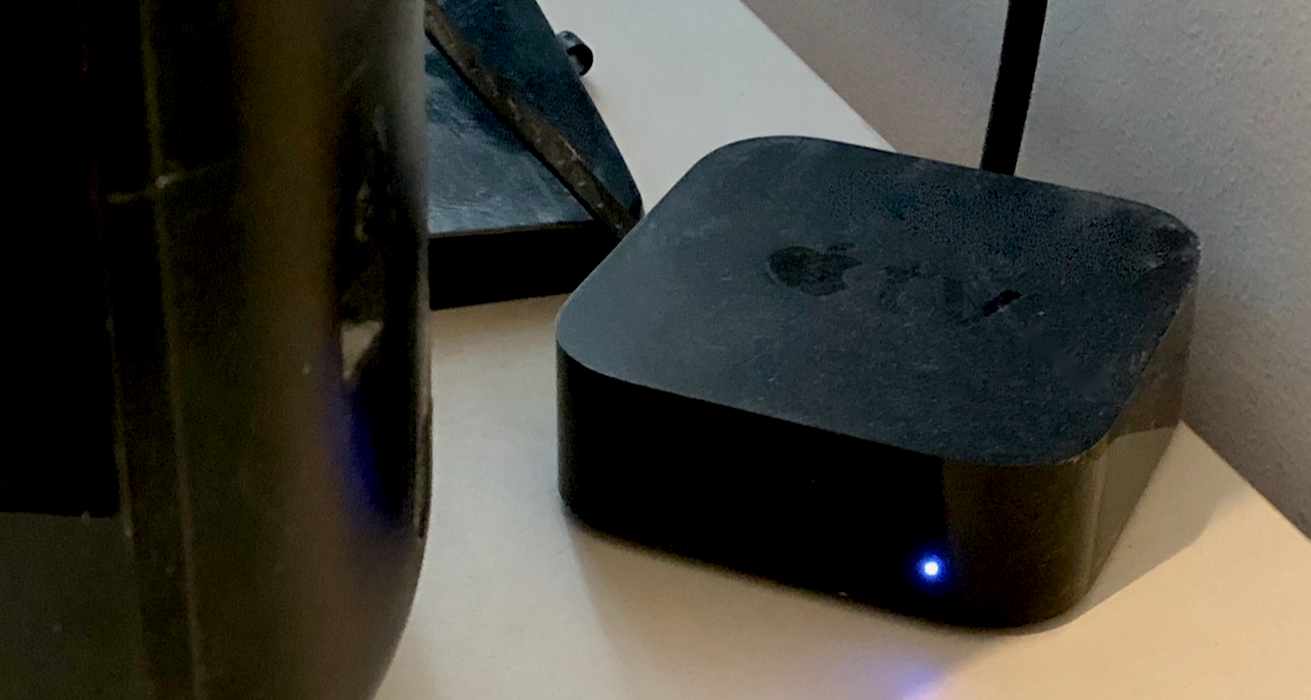
I am fairly certain, however, that a new version of the Apple TV - that little black box that fits neatly on a shelf and quietly gathers dust - will be announced around the time that macOS Golden Gate, iOS 27 and iPadOS 27 are released. This was made probable rather than possible by information on the new OS versions at WWDC in June. Features within the OS 27 releases require specifications that the current Apple TV does not have with its A15 Bionic chip. My Apple TV HD (A8 chip), which I have had since 2015 will not be able to use these new features, and is well overdue for renewal. Ryan Christoffel (9to5Mac) explains some of the AI features expected to be included in tvOS 27.
There is a caveat to this for local users. Ever since it was included in the AppleTV OS (named differently at the time), Siri was not available here. I still have to use that slippery black control device manually. There is, however, a rumor (see below) about new devices coming from Apple, and one of these is said to be a new Siri remote (Amber Neely, AppleInsider). Whether or not these new AI features will be available - we are not really sure what they are yet - is unknown. For a number of reasons, users here - who pay full price for Apple devices - do not always see the same features as are available in other countries. I suspect that language is one of the reasons (e.g. Fitness), even though most users here have some English competence. There are, however, other limitations some of which are outside the control of Apple: banking regulations for the Apple Card and Apple Pay (now available in Iraq, but not Thailand); delayed uptake for Apple Health features; and copyright, preventing access to some online services (movies, music, Formula 1).
I saw last week that Apple was providing users in the USA and other countries with free access to some classic movies. William Gallagher (AppleInsider) outlines the new offerings, including The Martian, iRobot, and Titanic, among a list of some 19 movies in the USA. He adds that users in the UK have a list of six movies and that these are all different. He notes that "This may not be available in every country. . . " and unsurprisingly, "Great Movies Available Now" on Apple TV are not available in my listings. However I was somewhat surprised to see that the Baseball games Apple now lists are available. I will remember that when I am having problems sleeping.
I was interested to see the announcement that Anthropic would watermark its output, believing that this was a step in the right direction of honesty, although I was not sure how this would work, or how a reader might see the evidence. John Gruber was initially pleased with this idea and expected that - having read the Anthropic information - this would be effected by the use of inserted characters. However, a second announcement appeared and it now seems that the watermarking will use "a form of steganography". Although this is unlikely to be the same as what I understand this to be: secret writing that [embeds]" the secret information in the least significant bits of a media file" Kaspersky. By the end of the week, Isabella Ward (Wired) had reported the claim by coders that they have already found a way to circumvent the watermarking. So much for another technological bright idea from the EU. And for the capabilities of AI developers.
 I perked up when I read the comment by Gruber that introduced the point that steganography was being used as I spent some time explaining this to students in a class on Ethics and Morals. This was in reference to Russian spies living in the USA as Americans, and the methods they used to pass information. Gruber links to the two allegedly contradictory items from Anthropic and also includes links to a relevant article by James Padolsey at declaude who looks at How AI Text Watermarking Works. As suggested, I downloaded this and read through the ideas.
Gruber takes "a stab at a layman's" summary of how this works. In the middle of this examination of what the watermarking does and how it works, Gruber compared two short sentences: "He leaped at the chance" and "He jumped at the opportunity". These have the same general sentiment, he writes, but the words do have different meanings and although they are similar, they are not the same. He adds, "The exact words we choose when writing matter." That is so, but along with this, the exact sounds also matter.
These are points I have tried to put over many times to some of those I work with whose English skills are not as good as they think they are. For example, when commenting on word choice, I was told that "crucial" and "important" have the same meaning, or that "Utilization" is a wonderful word. These are the same people who blithely check the grammar of a paper using AI, send it off to a publisher, then wonder why the journal rejects the paper and asks for the English to be checked. It is only then that I am asked to have a look.
The comments by Gruber produced a response from another real writer, who also objects to his writing being sucked up by AI and regurgitated without really understanding what the words mean. Don Moren (6 Colors), looks at what AI means for him as a writer who, like me, is aware of what AI can do, as well as the pitfalls, and declines to use such a method (and call it writing). He asks, "if you care so much about word choice, why are you using AI to generate text?" Gruber wrote a follow up to his initial posting as that has (understandably) generated a number of responses: positive and negative. This is also worth reading. He does mention that, like me, he does not use AI for any writing that he does: "I don't even use AI to write text messages or emails for me, let alone a single sentence of my work."
 He comments that if the detractors have little confidence in AI output, why would they think that AI watermarking would be trustworthy: "they've fallen hook, line, and sinker for the argument from Google and Anthropic that, thanks to them, they'll be able to" [detect AI output reliably]. Gruber's article here also mentions the post by Dan Moren, with which he fundamentally disagrees with at a philosophical level.
To support his comment that English is the finest language - the most expressive - he cites an interview between Jose Luis Borges and William F. Buckley, in which Borges says, "I have done most of my reading in English. I find English a far finer language than Spanish." He cites the mix of Latin and Germanic influences. These are the basics, but there are other languages. This means a richer vocabulary, as well as different grammar sets, which makes it difficult for learners.
I heard the same ideas from the Thai writer Pira Sudham who came to talk to young engineering students as part of the English teaching about 30 years back (I have been here a long time). We chatted in the transport on the way back to Bangkok, he mentioned that he did not tell the students, as they might not fully understand, but he did all his writing of the stories about ordinary Thai people in English as he found the wide vocabulary allowed him to express himself more effectively.
While we are on AI, there have been reports in the last month or so that claimed the AI companies were buying up thousands of used books and scanning them. That was one thing - stolen words and ideas to train the AI Behemoth - but the second part of the reports suggested that the scanning process itself was destructive. I just wonder why the booksellers do not decline to sell their stock when these massive, unselective orders are placed? There must at least be some suspicion of their eventual destination and destruction without the use of tracking - too late by then.
Now, a report has surfaced that tells us that an AirTag was placed inside a shipment of 1,000 books which eventually found its way to an Amazon warehouse in Las Vegas where books "are received, sorted, and then processed." That processing includes cutting the spines of the books and feeding the pages through scanners, creating data. Amber Neely expands on this, explaining why this is a never ending process as the AI data "condenses down so much that it becomes useless" - model collapse. In the end it could be that all output is identical. It is already easy enough to identify by a native speaker.
In the midst of these questions about AI, Jill Lepore (Guardian) takes a look back at how people thought about the arrivals of computing devices and how data could be used in "Democracy v the machine: the birth of the digital age and the warnings that were ignored". There are some gaps, but there are some unusual insights, along with the warnings no one heeded. No one is listening now. That Lepore article was followed by a review of her new book, The Rise and Fall of the Artificial State in which she writes about the emergence of a democracy-crushing dystopia, which may already be with us: the master plan of Musk, Zuckerberg, Bezos, Thiel, Altman et al (Farrah Jarral, Guardian). I placed an order with the Guardian for a copy of this work.

Graham K. Rogers teaches at the Faculty of Engineering, Mahidol University in Thailand. He wrote in the Bangkok Post, Database supplement on IT subjects. For the last seven years of Database he wrote a column on Apple and Macs. After 3 years writing a column in the Life supplement, he is now no longer associated with the Bangkok Post. He can be followed on X (@extensions_th). The RSS feed for the articles is http://www.extensions.in.th/ext_link.xml - copy and paste into your feed reader. No AI was used in writing this item.

For further information, e-mail to
Back to eXtensions
Back to Home Page