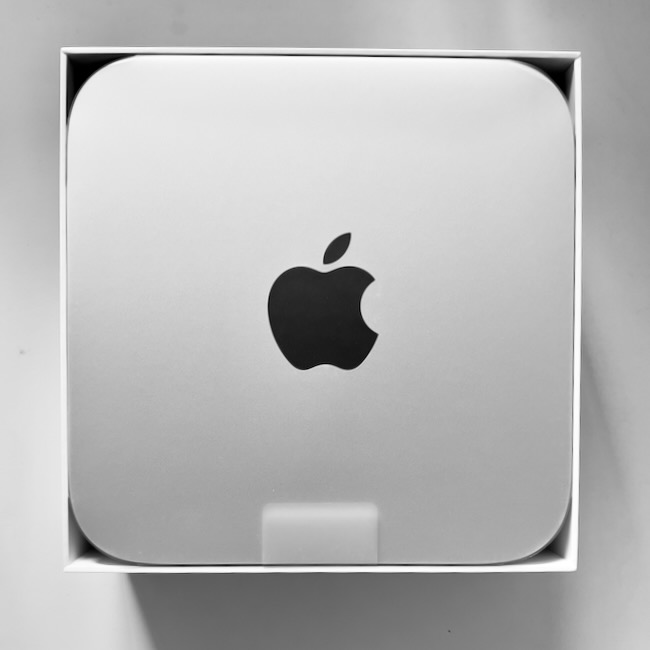
eXtensions - Friday 10 July 2026
By Graham K. Rogers
AN update to the photo app Halide (now 3.1.1) arrived this week. When looking at a problem with an external disk, I tried a couple of utilities, as well as Apple's Disk Utility on the Mac. By coincidence two other helpful utilities arrived: Glenn Fleishman's Mister Plimsoll; and WhatCable that reveals some valuable data about ports, cables and disks attached.In Britain, politics took a turn, with a comedic character facing off in a by-election against Count Binface.
One of my favorite photo apps, Halide, was updated this week with a number of enhanced features and a couple of additions. I prefer to have the display set up with a monochrome display and set to a square. When I use the Noir filter for the display, that also produces images that are black and white. I am usually quite happy with that, but once in a while a photograph needs to be in color.
 As all the images I take are saved as RAW, that is fairly easy to accomplish by also saving a copy of the original. In the 3.1.0 update (now at 3.1.1) a new filter has been added: Scarlet. Despite its name it does not have a harsh red output, like the Harman Red film I use. Indeed, on some early shots, I could hardly detect the red, probably because of the subject so this is quite subtle. It is described as having "more warmth, richness and medium-high contrast".
As well as minor improvements and bug fixes, other changes to the app include improved frame controls when editing, a compression control for "finding the right balance between texture and file size", exposure bias reset, always-on focus tools, a RAW-only look that does not save a JPEG that comes with a warning with regard to using this "only if you know what you are doing", and an exposure/focus lock. As a complement to the release, Ben Sandovsky has written an article on Lux in which he explains the changes and some of the reasons. Best wishes too, for the safe arrival of Isaac.
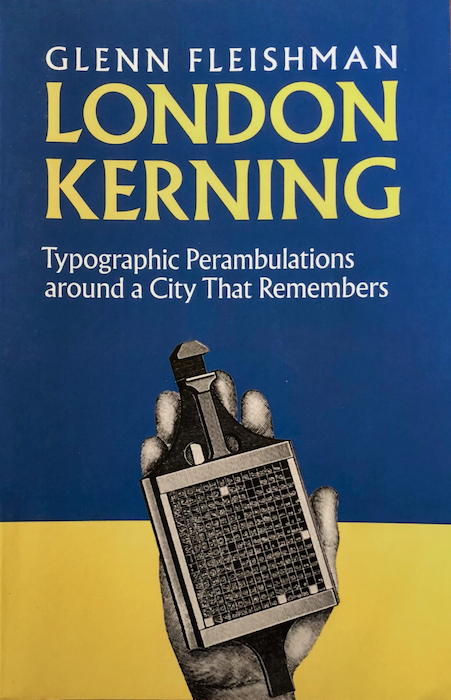 Longtime Mac users will know the name, Glenn Fleishman, who has written for A number of sources including MacWorld. He is one of the authors who writes those "Take Control. . ." books. He was also a 2-time winner on Jeopardy. Among his other interests is typography: the study and history of printing, including its terminology. I was aware of some of the terms from my days working in the wholesale newspaper industry in London in the late 1960s and their relationship to churches.
The union head at a workplace, for example, was known as the Father of the Chapel; and the shape or type of print is called a font. The lead type was kept above the working area, with capital letters in the top level and others below. From this we have upper case and lower case letters. One of my favorite examples of Glenn's work was a book he wrote about the historical London world of print, London Kerning. I bought 2 copies: one for me, and one for my stepfather who had been a printer and who was delighted by the book.
A note on Boing Boing (Rob Beschizza) this week mentioned another part of Glenn's output: a small utility, that in the best tradition of the Macintosh, does one thing and does it well. His app, Mister Plimsoll, which is accessible from the Menubar reports on the amount of disk space ava in a quick-read panel. The name comes from the Plimsoll Line on sea-going ships that indicates potential risk from overloading.

The data displayed by the app is updated hourly, although the frequency can be changed in Settings from 1 minute up to 24 hours, or Other: the user can set a specific interval. The Settings also has ways in which the user can be notified, particularly when the lack of space is pressing. As well as the MacBook Pro I usually keep at home, I installed this on the MacBook Neo and on the Mac mini I use at work. On that, the Volumes panel showed the external disks that are permanently attached to the device, so I added them to the monitoring list.

The display also appears in the menubar panel giving me a quick and easy way to check space available on each of the disks. The "purgable space" shown is not a problem. Although there are ways to remove this, the system will use this as and when this is needed. Restarting the Mac can also free up some (if not all). Although the app is free, there are options in Settings to send the developer a tip. In my case this is in baht: 29, 79 and 199 baht. That was easily effected and the app produced a response showing gratitude. I used the MacBook Neo to make the transaction and shortly after I was sent email from Apple telling me that the device had not previously been used to make a purchase. I can safely ignore that, but it is nice to see Apple trying to keep me safe.
Last week, Final Cut Camera was updated and I took the opportunity to check out the video output of the basic Camera app on the iPhone. Some may remember the Apple Event that was filmed totally using the iPhone 15 Pro a couple of years ago, using the ProRes settings (and a lot of professional camera accessories). I was interested in being able to work with that if the need ever arose, so tracked down a Samsung disk in a store in central Bangkok, and tried a Thunderbolt 4 cable I had. It did work when I first tried, but a while later, it kept reporting that the device was not able to record at the required write speed. The arrival of the Final Cut Pro update spurred me to have another look.
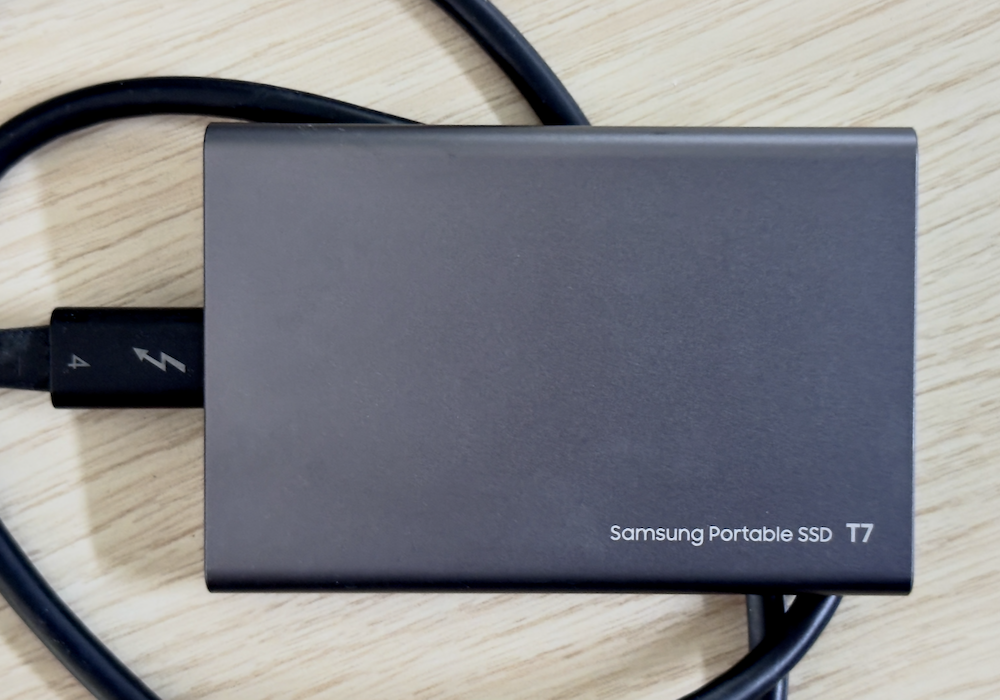
My first attempt was made using a CalDigit Thunderbolt 5 cable. I do not actually need T5 for any of my devices, but it is good to be prepared and the price was good, even when delivery charges were factored in. With the Apple case I use for the iPhone 17 Pro, the cable would not go into the USB-C port. Closer examination showed that the squared-off cable end was too large for the opening. I tried a Thunderbolt 4 cable and that slid into the port perfectly. When I removed the iPhone from the case, the Thunderbolt 5 cable connected properly. I wondered whether I could use a file to enlarge the slot and discussed this with a colleague. He suggested that I should first look at the relative speed capabilities of each cable.
|
|
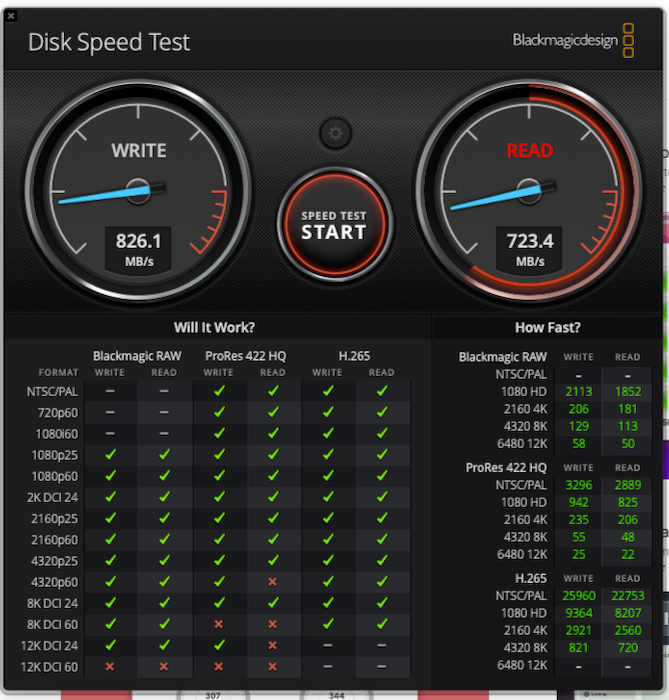
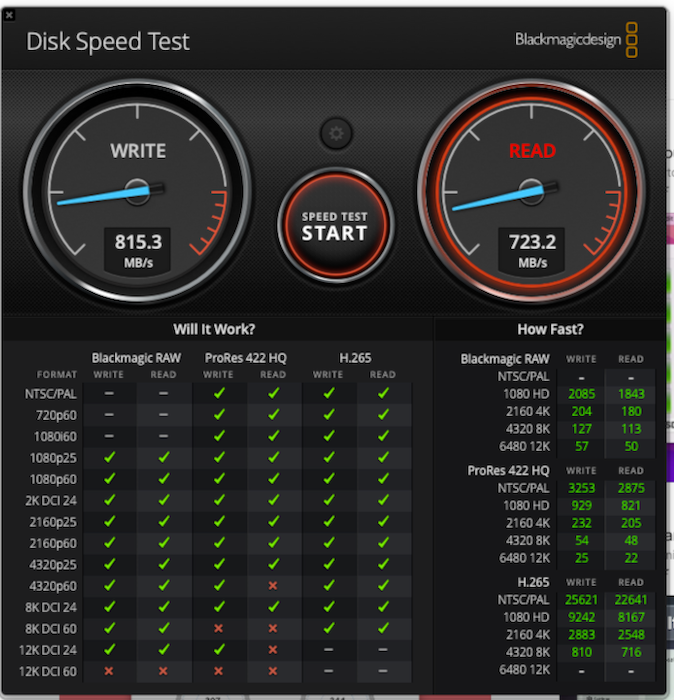
I later downloaded the BlackMagic Design disk speed test app and found that both cables would read and write at similar speeds with the disk I kept for ProRes recording. The acid test would be how they worked with the disk. Initially neither worked.
Some further investigation took me to an Apple Support Document that outlined what was needed. I was slightly surprised to see that, rather than the macOS (extended) format I had used, the disk used "must be formatted with exFAT." An additional comment was that "You must reformat your external storage device before beginning each 4K120 ProRes recording session to ensure optimal performance." As soon as I reformatted the disk to exFAT I was able to use both cables to record video in ProRes. I shall keep the two cables in my bag with the disk (spares are always useful), but in normal use I would expect to use the Thunderbolt 4 cable to avoid unnecessarily removing the iPhone from the case.
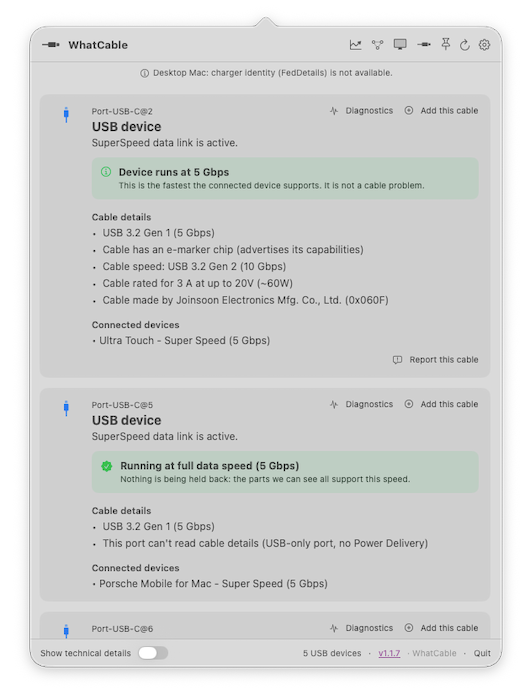
In a perfectly-timed article, Dan Moren (6 Colors) reports on an app "from developer Darryl Morley" that checks the speed capabilities of cables. "WhatCable looks at your Mac's USB ports and anything plugged into them" then reports the capabilities - speeds, power supply, and maximums - displaying the data in an easy to read panel. This is a free app, although there is a $9.99 Pro version with additional features.
|
|
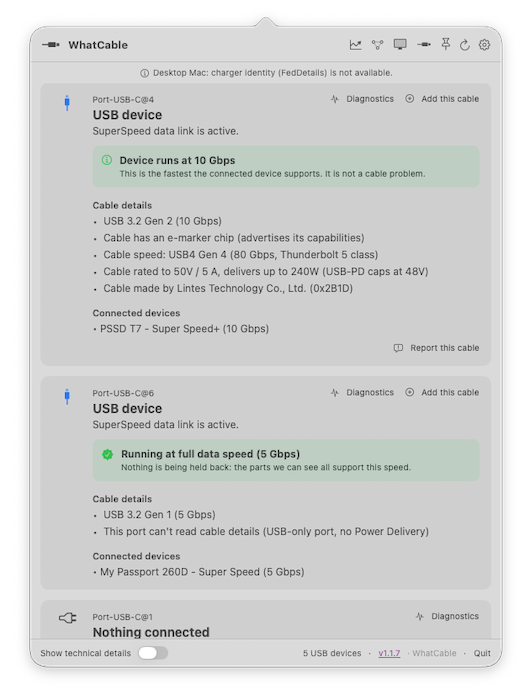
I used it on the M4 Mac mini in my office and was pleased to see the amount of detail that was shown, as well as the limitations of ports, cables and disks. The ports on the front of the Mac mini, for example, are data only (not power) so full details of the cable cannot be read. The rear USB-C ports are different, but a cable capable of 10Gbps was limited by the maximum speed of the disk. I also tried the Samsung disk that I bought for if I ever use ProRes video and the OWC branded Thunderbolt 5 cable.
That was identified correctly, including the manufacturer - Lintes Technology, a Taiwanese company that has facilities in Chonburi, Thailand. It was interesting that the CalDigit Thunderbolt 4 cable was also made by Lintes. The app readout also showed that the limitation was that the disk runs at 10Gbps, so the cable was capable of faster speeds than the disk (which I already knew). Thanks are due to Dan Moren for bringing this useful utility to our attention.

I try to avoid politics on here, unless politicians try to interfere with the ways we run our devices. However, a prominent political figure in Britain, has been receiving some criticism recently concerning sizable "bungs" (as the commentator Piers Morgan phrases it). This politician has always reminded me of a "spiv" (Oxford Dictionary - typically a flashy dresser, who makes a living by disreputable dealings). There are plenty of examples listed by a web search, including one played by George Cole in the series, Minder on British TV. It is less of a phenomenon in the USA although there are similar types of semi-underworld characters.
After trying to face the criticisms down, and with a Parliamentary inquiry in the background, this politician resigned his seat, forcing a by-election. The area of the Clacton constituency also contains 2 other towns (and some smaller villages): Frinton and Walton. I lived in Walton-on-the-Naze for a couple of years in the late 1960s where my father ran a small hotel. Frinton, which is apparently the location of a house that has been brought into the allegations, has for many years been synonymous with wealth. It was as if time had been frozen there and everything looked like the 1930s. There were two ways in to Frinton. One was a back road that only locals knew. The main route passed over a level crossing and if it was too busy it was said that the gates would be shut. Clacton where the majority of the population live, is somewhat different.
The imminent by-elections, which may not take place for a couple of months, has been enlivened by two factors: the main political parties will not be running, claiming it is a political stunt (if he wins, the Parliamentary enquiry continues); and the inclusion of someone who is normally a fringe candidate, livening up the event, Count Binface (Ben Quinn, Guardian). This is the public persona of a comedian, Jonathan David Harvey. A Google search brings up a significant number of links, including one that refers to him as "a veteran satirist, comedy writer, and performer who work blends sharp political insight with theatrical absurdity" (Great British Speakers).
His list of writing credits is impressive. Douglas James (Dorset Eye) expands on the information, adding that Harvey (Binface) graduated from Oxford, and outlines his writing career. "That background inevitably changes how Count Binface can be viewed." He is, James writes, "someone with deep experience in political satire and close links to Britain's established comedy world. . . . He is an extension of Britain's long tradition of satirical comedy, bringing television-style political humor directly into the electoral arena." He concludes that it is "the experience, writing talent and understanding of political theatre inside the costume that make the character work."
Normally such candidates expect, at best, a few hundred votes, but there has been unusual interest in this by-election and some are hoping that he has a chance. Betting organizations have shortened the odds, and by Thursday there had already been some £15,000 from voluntary contributions. More is being added daily. He has been interviewed on TV and radio, and has produced several witty remarks. He claims that his best advantage is because of the name (and reputation) of the man he will be running against; and in one interview he called the by-election a "cunning stunt." When asked about removing his bin covering, were he to be elected, he made some good comments concerning precedent. Despite being a candidate who is expected never to win, he is gaining momentum.
And we should also give a nod to Screaming Lord Sutch who paved the way. Sutch stood as a candidate in "39 [elections] between 1963 and 1997" (Wikipedia) with never a hope of winning. But what did that matter? It should be noted that some of his election promises, like lowering the voting age, and pet passports were taken up by mainstream political parties, although originally they were not viewed seriously.

Graham K. Rogers teaches at the Faculty of Engineering, Mahidol University in Thailand. He wrote in the Bangkok Post, Database supplement on IT subjects. For the last seven years of Database he wrote a column on Apple and Macs. After 3 years writing a column in the Life supplement, he is now no longer associated with the Bangkok Post. He can be followed on X (@extensions_th). The RSS feed for the articles is http://www.extensions.in.th/ext_link.xml - copy and paste into your feed reader. No AI was used in writing this item.

For further information, e-mail to
Back to eXtensions
Back to Home Page