
eXtensions - Tuesday 23 June 2026
By Graham K. Rogers
An event at the university last week kept me busy with writing, and with organizing hundreds of photographs. The UK Labour government plans to bring in laws to prevent teens under 16 from using some social media. We remember other political pronouncements on the use of technology. Labour lost its PM this week. A feature in Accessibility, helps those using handheld devices who suffer from motion sickness. Some comments on AI in writing.
 Over the last few days I attended a symposium put on by the Faculty of Engineering at which there were several events. There were the usual opening speeches, after which lecturers, speaking for 10 minutes each, outlined ideas that would help Thai industry. The ideas focused on up-to-date technology and ways in which is could be used: AI, digital twins, logistics, et al. I had done a preview of the event that went out a week before, but on the day I was asked to take photographs. At my pushing, one of the deputy deans is keen on updating the Faculty website and that includes images. I was able to take a number of candid shots.
Last week I went through an additional photo library with my images from the days I had used Aperture. I was looking for older photos linked to the Faculty. I was able to retrieve a couple of hundred more going back to 2009. I made a PDF of thumbnail images so I can later retrieve any that are needed. While looking at the contents of the older library, I found over 400 of my early film images (mainly black and white). A lot of these are sub-par as I was in the early stages of learning how to use the cameras, and relearning how to use film. The photos I take now are much improved.
At the Faculty's Synergy 2026 event I managed to take almost 450 photographs with the Nikon as well as a few more with the iPhone. I prepared another PDF of thumbnail images for others to examine. Many of these photographs were duplicate images, with some out of focus of course. I dumped those as well as images in which the faces are not fairly represented: the position of eyes and mouth often spoil a photograph and I dumped those. In the end I had over 300 images, from which I selected about 50 for the web. It took me a couple of days to write the review of the event and liaise with others at the university - they like to check facts and, especially, make sure that titles are correct. I managed to finish this Sunday lunchtime and posted my Synergy 2026 report online just before the Czech MotoGP from Brno.
The Labour Government in the UK created a stir last week when it was announced that social media would be restricted to those over 16 when legislation is passed later in the year. This follows the similar Australian move which does not appear to have gone as well as the politicians had hoped. The EU is also considering a ban on social media access for those under 16 (RTÉ). Labour has an odd relationship with personal freedoms and has tried to bring in other restrictions in the past. Their redefining of terrorism has created an unusual situation in which the police are now able to arrest old ladies carrying signs that the government does not like. The social media restrictions on young people have, at their heart, protection of the kiddies, in much the same way that other internet restrictions always cite child pornography, terrorism and organized crime when trying to limit user access in the UK.
 I have zero problems with cutting excessive screen time. I would prefer it were done by the young people themselves or their parents rather than a Nanny government. Several countries have come to the realization that, while there are certain benefits to the use of tablet computers and other hand-held devices, their young people are losing skills (like reading) that many of us take for granted. If only some more enlightened souls would come to a similar realization that blanket use of AI, particularly in writing reduces the thinking abilities of those who take this short cut, but end up producing content that is not as good as they think it is (see below). It is not a free go as some seem to think.
A number of young people make good use of social media and they are just to be cut off from this resource. These include some nature and landscape photographers, as well as those who comment sensibly on their surroundings using video. As Lewis Goodall (Goodall and Good Luck) notes, among several comments questioning the wisdom and motives for the government's announcement, Labour is about to allow these same young people to be allowed to vote. Mike Masnick (TechDirt) who often makes informed comment on matters linked to the law, to modern communications, and to freedoms, as well as about less than sensible decisions made by those in authority, calls this "political theater".
He notes that everyone thinks [the current PM is] doing a terrible job, so reaches for the "techlash" - a reliable political life preserver. Masnick adds that he is "a technologically clueless bureaucrat who thinks that societal problems can be solved by making tech companies do the impossible". He adds that the Australian experiment has been a total joke as the majority of kids, who are far more tech-capable than politicians, soon figured out how to circumvent the restrictions. The rest of the comments are well worth reading. As had been predicted, Starmer is no longer PM. Did he jump or was he pushed?
My mind flew back to 2015 and the Charlie Hebdo attacks in Paris (Le Monde) when many political leaders descended on the city. David Cameron, British PM (Tory) at the time, called for a ban on messaging services like Snapchat and WhatsApp if British intelligence services can not access them Sam Frizell (Time) [my italics]. It is a long-held wet dream of GCHQ to have free access to all messages in the UK. As Apple has long commented, once you open a back door for law enforcement, it is open for all (including the criminal element). When the headlines faded, and sensible minds like those in finance had their say, while other groups reminded the politicians that all their messages too might be at risk, the pressure seemed to evaporate.
On my trips to the UK about 10 years ago, I rented a couple of nice German saloon cars. I paid with my credit card and the exchange rates were favorable. I enjoyed driving round the English countryside and took the time to visit several preserved railway sites, including the Didcot museum and the Gloucestershire Warwickshire Steam Railway. I took my sister and her two girls to the GWSR using some of the roads I had driven on when being taught to drive police cars.

|

|
Despite the beautiful countryside, one of the girls had her face buried in an iPad for most of the journey. However, near Stow-on-the Wold, I was asked to stop as she was feeling unwell: motion sickness. Reading a book is just as bad. With the movement of the vehicle (train, boat, car) the eyes sends conflicting signals to the brain. Apple has a solution that works on the iPhone and the iPad.
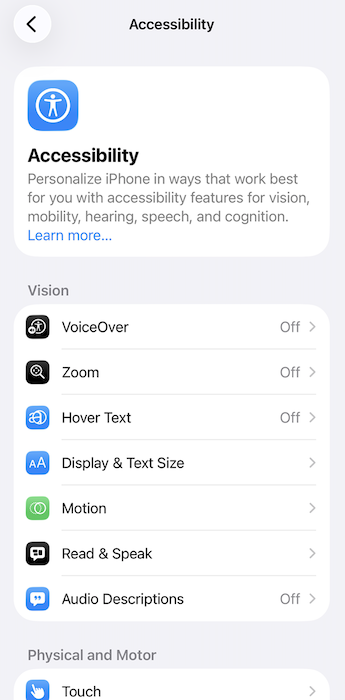
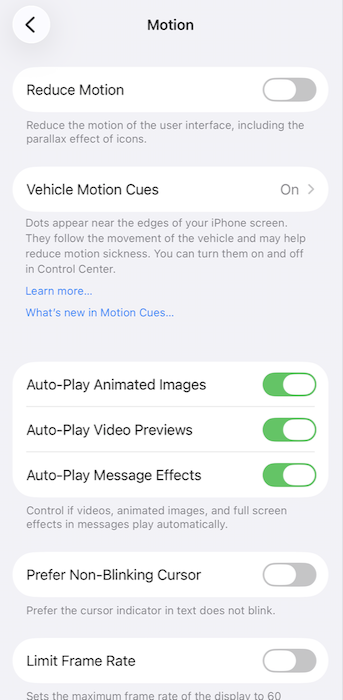
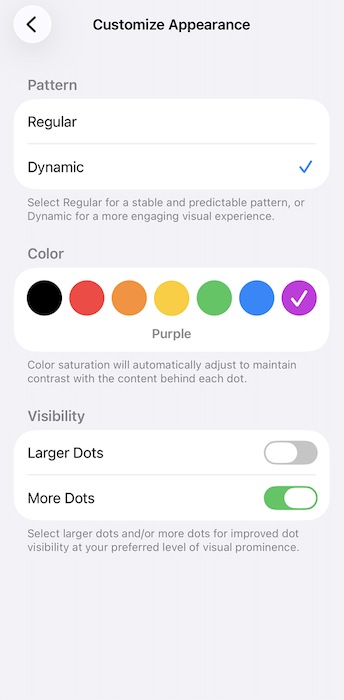
I was first alerted to this by Boing Boing, although (like other sources) they had picked this up from Thomas Ricker at The Verge. Vehicle Motion Cues is an Accessibility feature that displays dots round the edge of the screen. These move when there is motion input. I changed the feature from On to Automatically in Vehicle after a few days. That worked quite well and the dots appeared once I was in a taxi, but disappeared when my journey was done. Using Customize, I had also changed the color from blue to mauve after being slightly confused when checking email, which also uses blue to indicate unread messages. The dots move around even with slight motion, but they do not appear in any screenshots.
|
|
|
News is still trickling down after WWDC, and now that the first beta releases are being examined. Ryan Christoffel (9to5Mac) writes about what is new in Photos in iOS 27. We had already discussed the AI Extend and Reframe tricks. Apart from trying out this feature, I am unlikely to use these features. Also new are the upgrades to iCloud sharing. And a revised Clean Up. Nope. What the coming update to Photos does not appear to do is to update the respective interfaces or the current tools and how they work. There are also features missing from the suites such as better metadata displays, which would be better introduced before Apple's circus tricks.
I mentioned recently (and have done before) my slim hope that Apple will one day release a modern update for its Airport Router. As has been reported, Time Machine - the router plus back up disk - will no longer work with the update to macOS Golden Gate. My reliable Airport Router is not affected. This week, Apple announced that the Airport Utility app is also going away soon (Marcus Mendes, 9to5Mac). Hope seems to be diminishing. It seems to be slipping further away, unless Apple is clearing the desks for a new version (hopeful I know). I am not alone in keeping my fingers crossed as D. Griffin Jones (Cult of Mac) lists Airport among 10 Apple products he thinks should return.
 Writing is thinking. I am critical of the use of AI in academic (and certain other forms) of writing. Leaving the task wholly to AI avoids the need for honest research. The results, especially for those who are not native speakers of English, is not well-formed content, although the writer may not be able to identify this in the way a native speaker would.
The use of AI to check grammar also has pitfalls. The tools sometimes miss certain grammar points, such as prepositions or verb tenses. Another problem that disturbs me is that when writers use AI to check grammar, some words are arbitrarily changed: synonyms replace perfectly serviceable words. This is unwanted, and outside the remit of the AI tool. A word that the writer had specifically chosen may be replaced by the AI and the writer may not understand why.
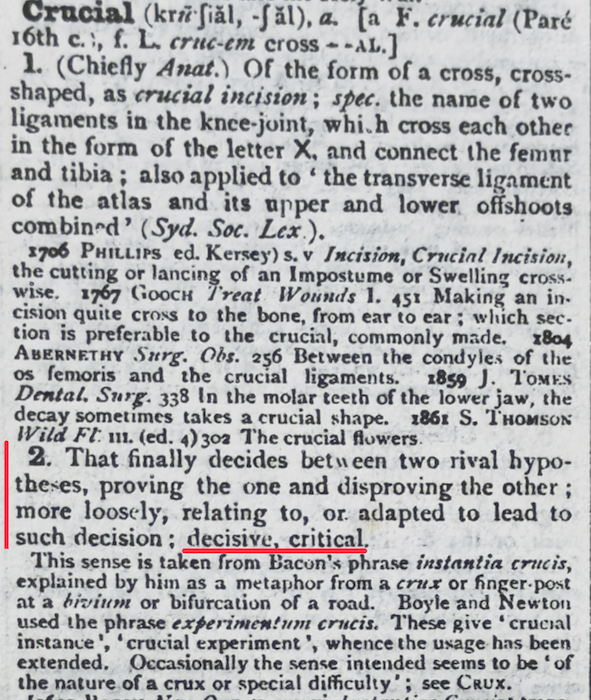
Whenever I see the word Crucial, I worry about the use of this in an academic text. Actually, I want to scream. It tells me that the writer has just accepted the AI output. It may not mean what the writer thinks it means. It comes from the Latin, Crux/crucis - a cross. The Oxford English Dictionary (I have one in my office) includes in its definition the point that this is considered to be a decision point, offering alternatives of "decisive" and "critical".
These are absolute words. Like a superlative, there is nothing higher. Many treat this word as if it means important (it may do, but in specific ways). Similar care should be applied to Critical, which implies a life-threatening situation. Crucial and critical, and a number of other words, indicate to me, and to the editors of academic journals, that AI has been used in the creation of the content.
Other words which are indicators include Foster, Advocate, Enhance, Garner, Transcend, Thrive, Utilize (and their derivatives - in context "use" the noun and "use" the verb cannot be confused, in oral use, less so). And many more. Delve used to be a well known marker, but ChatGPT changed the algorithm and that appears less these days.
With regard to use of AI in academic papers, this region was recently shown to be an area in which the use of AI in articles had grown most. That would suggest the publishers, (A) are identifying the output, and (B) reacting when papers are submitted from these areas (See below).
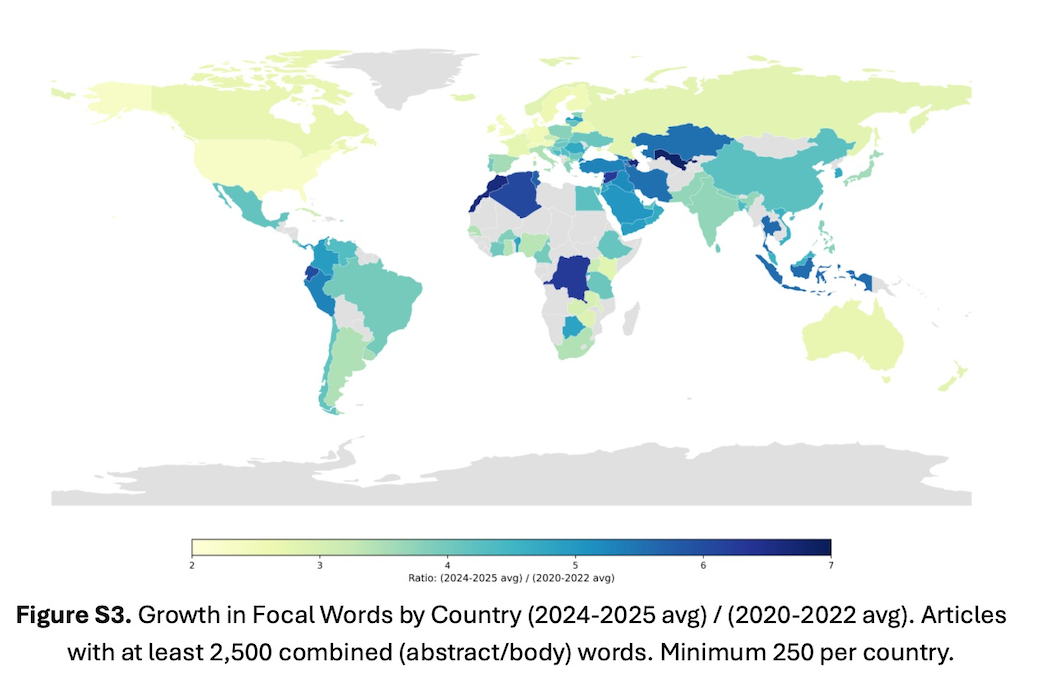
Good English is recognized as much by its sounds as its grammar and word choice: juxtapositions (users use devices), accidental rhymes, homonyms and other unintentional choices all affect the reader, as does the sentence length, and general readability. Many of the papers I see score poorly on this (if I have to read a sentence 4 times to understand it, that does not pass muster). Journals take this into account when considering a submitted paper. Just because a long word is used, does not mean it is the right word. Although the LLM coughs up a paragraph with English words, it does not mean that the output IS English. Some of the convoluted, twisted prose that I have read in the last couple of years would not be worthy of an American Junior high student. I taught remedial groups of freshman writing classes in the USA so have had some experience of this.
While I have faith in the potential of some AI use, there are too many examples of weaknesses and dubious output to make me happy, particularly with regard to writing. This week it was reported that a reanalysis of information using AI was able to diagnose several cases of genetic illnesses that had previously remained undiscovered (Aaron Jaech et al, NEJM). In the meantime, Emmanuel Maiberg (404 Media) reports that "Google CEO Sundar Pichai proudly tells the world that 75 percentof all new code at the company is AI-generated". Internally, however, Google employees are "sharing memes about how AI is bad at that exact task and makes their job harder." Joseph Cox (404 Media) follows up with news that Google employees have now begun making and circulating memes about how bad their AI is, with Emmanuel Maiberg (paywall) writing about Amazon employees who have a similar gripe - and memes. In the meantime, Sundar Pichai is another CEO who had to face boos and walkouts from graduating students: this time at Stanford, with the students unhappy about Google's defense ties to Israel, and services provided to ICE (Lucas Ropek, TechCrunch).
In a cruel coincidence, I have just been asked to recheck a paper for perhaps the 4th time. Despite already pointing out that the AI content and grammar checks were not producing good English content, this has been ignored. Now the editors have returned it again with a note on the English which is "not so good", adding that it has a number of inappropriate expressions. Unlike Google where the coder fixes the work, it falls to me to repair what I had already commented on. Maybe we can dispel the idea that AI tools are not the magic spell that some believe them to be.
Graham K. Rogers teaches at the Faculty of Engineering, Mahidol University in Thailand. He wrote in the Bangkok Post, Database supplement on IT subjects. For the last seven years of Database he wrote a column on Apple and Macs. After 3 years writing a column in the Life supplement, he is now no longer associated with the Bangkok Post. He can be followed on X (@extensions_th). The RSS feed for the articles is http://www.extensions.in.th/ext_link.xml - copy and paste into your feed reader. No AI was used in writing this item.

For further information, e-mail to
Back to eXtensions
Back to Home Page