
eXtensions - Monday 12 January 2025
By Graham K. Rogers
Apple Q1 2026 earnings at the end of the month. New Apple products & succession rumors. New cables ordered here as part of a new year tidy up. Lost disk recovery thanks to Windows NT. Low iOS 26 take-up reports: is design the key?
Apple has announced that it will release its Q1 2026 earnings report on 26 January. If things go as normal, we can now expect a range of negative reports on the company, followed by a fall in the share price after the announcement. Wall Street only seems to look at Apple in the short term, and few analysts understand the long term strategies that Apple is working on, usually in the background. I was reminded of this mid-week when I read one of the historical articles on Apple that Cult of Mac puts out regularly (Luke Dormehl). It covered 6 January 1998, when Steve Jobs was interim CEO. I had forgotten that it was so long ago. At an event, he announced that, after some serious cost-cutting, Apple had returned to profitability. It was nothing like the figures we see now, but even $45 million was a good sign. Not for Wall Street.
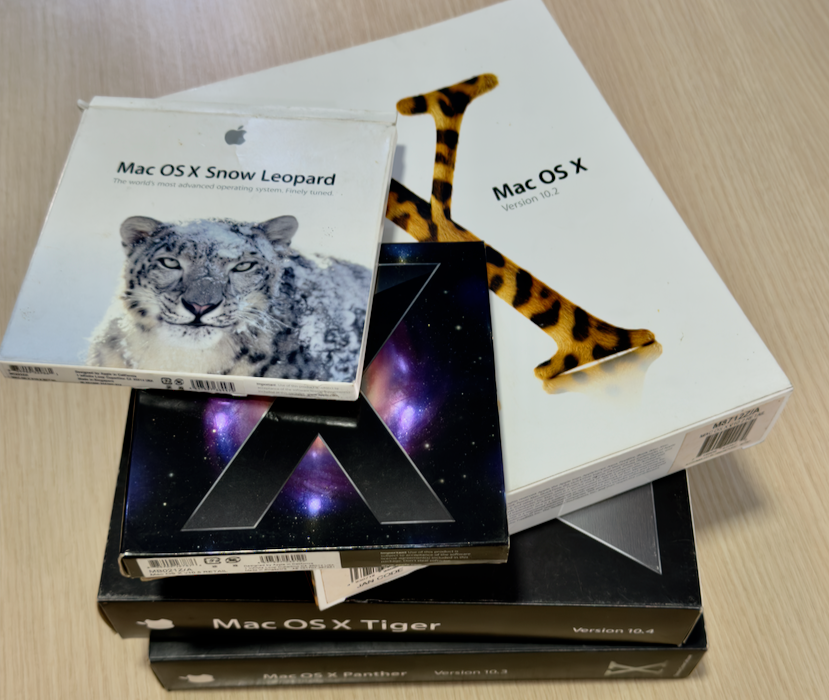
Despite the positives that Luke Dormehl outlines, including higher than expected sales for the G3 Power Mac, analysts still expected Apple to shrink. As Dormehl notes, market share was still reducing. What Wall Street did not know, was that one of the products in the pipeline was the translucent iMac. I guess that at the time they were also working on future iBooks (released in 1999) and the upcoming OS X. That arrived initially as OS X Server, also in 1999, with OS X, Cheetah, released in March 2001. About that time, I had access to a G4 Power Mac, which had System 9 and OS X installed.
I used System 9 on a daily basis, but one day decided to try the new stuff. It was so different that I exited within a couple of minutes returning to the safety of the (then) traditional System software. I started thinking about what I had seen and realized that Apple had bet the company on this and would not be going backwards. I had another look and the sense behind OS X took root. I never went back. I also realized that few people (especially in Thailand) understood the new OS, so persuaded the Bangkok Post, Database to let me run columns on this. They reluctantly agreed to one column every fortnight. After I was invited down to Phuket (one month before the Tsunami) to chat to a user group, the columns switched to a weekly format. As a direct result I was later invited to MacWorld in 2007 where a new product was launched. From little acorns. . . .
I see that now Tim Cook is around retirement age, a number of sources are stepping up the conversation on his succession, with John Ternus top of the favorites list apparently (Andrew Orr AppleInsider). That is not a bad choice all round, but despite the preferences shown by some media sources, and the pressure certain of these have been putting on Cook for years, we are only certain that Apple does have a succession plan (stupid if they didn't), but who is on top of the list, despite the excellent credentials of Ternus, is known only to an elite few within the corporation.
Later in the year we are expected to see new Macs. Among these it is expected that a MacBook Pro will be developed with the M6 chip. As almost all the plumbing is on the chip itself - SOC or system on a chip - newer devices are expected to become thinner. Ryan Christoffel (9to5Mac) comments on this thinness and wonders how much of a risk it might be. The limitations are not in the design of the circuitry but with the industry-standard ports and there is little that Apple can do about IEEE specifications.
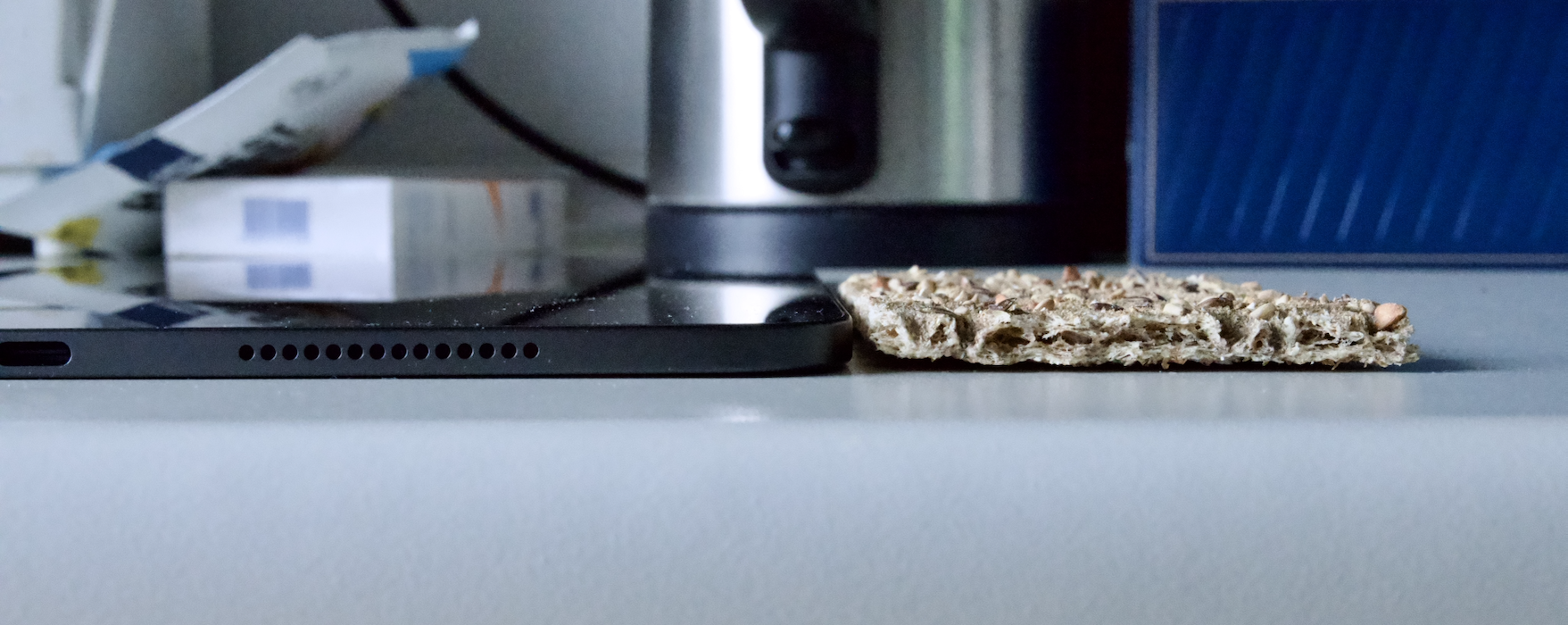
The company has covered this point before: as the body becomes thinner, physics comes into play and the device can flex, or become weak at particular stress points. This was covered last September with the iPhone Air which comes in at 5.6mm, despite the size limitations of the USB-C port. My current M4 iPad Pro, is also quite thin and when it arrived I compared it directly with Ryvita crispbread. There is not much metal at top or bottom of that port, but I have seen no distortion in the body in the time I have owned it.
Because of the ability to create ultra-thin devices with the new SoC chips and thinner batteries, there has been some speculation on the idea of a computer in a keyboard. Roman Loyola (MacWorld) reports that HP has announced just such a product at CES which has just finished. A potential shortcoming is that the keyboard needs a monitor with ports to link to any other devices via its USB-C cable. This has Thunderbolt 4 throughput, although we might note that Apple is already using Thunderbolt 5.
As part of new year maintenance and tidying up, I ordered some micro-USB to USB-C cables online. I have a couple already, and had given some of these away when friends acquired USB-C devices, but trying to find any such cables here, despite the high number of external disks (and other equipment) that use micro-USB is an impossible task. When I first grumbled about this online a few years back, someone from Belkin sent me a message saying that they had just what I wanted. I ordered some right away. I later replaced them with other cables, but I thought it might be an idea to buy some spares.
Although Apple has Thunderbolt 4 and Thunderbolt 5 cables available here, they are a bit expensive and I had seen some cheaper versions online. I went looking in central Bangkok shops. Like the USB-C to micro-USB cables, many retail assistants have no idea that these accessories exist. I did eventually find one Belkin Thunderbolt 4 cable in a store on the 4th floor of Siam Paragon, but this was 2m - a bit long for my needs. I prefer 1m to keep things tidy. I had some CalDigit Thunderbolt 4 cables and they do carry the newer 5TB cables, but the ordering was confusing.
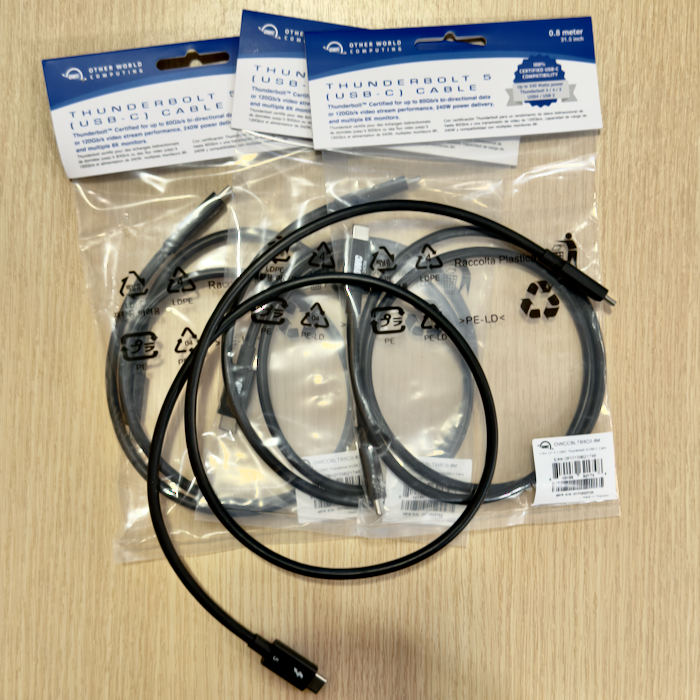
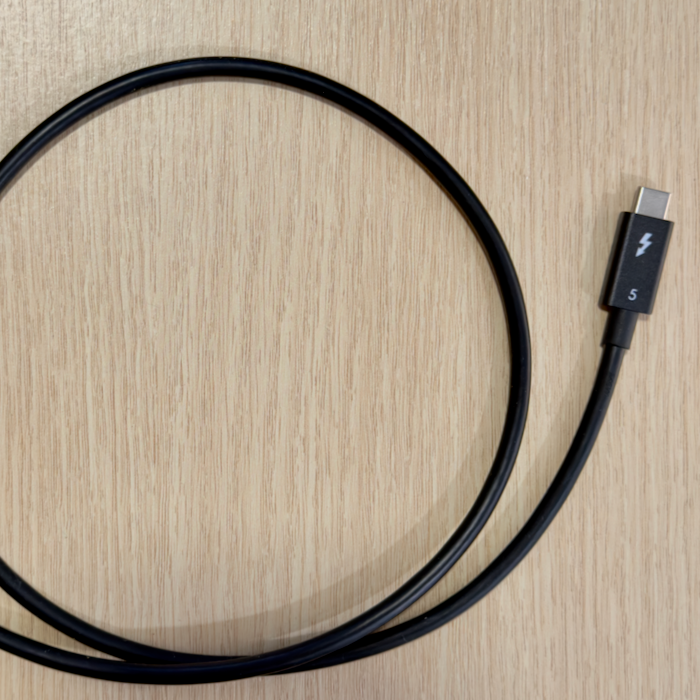
Eventually I bought 4 x 1m Thunderbolt 5 cables from Other World Computing (OWC) whom I have used before. 3 of these cables were $19.99 each (special offer) with the 4th another $27.99. Shipping was just under $30 for a total of about $116 (3650 baht). The 1m Apple cable is 2490 baht here, although I now see the online store has a 1m CalDigit cable available for 1,090 baht. Including shipping, my OWC cables came to 912 baht each, although there will be additional tax of 814.25 baht, making each cable 1,115.50 baht.
|
|
The package was on its way within a few hours and was scheduled for delivery on Friday (3 days after the order). They were on my desk when I went in on Monday. I never have those speeds from Amazon. My film ordering from Hong Kong does sometimes deliver within a few days, but at other times, the package is lost in the system (trackable, however) and has been seen in Japan, before returning to Hong Kong. On another occasion the package came to Thailand, then to Vietnam and back to Hong Kong before it was delivered. This is the courier, not the film shop.
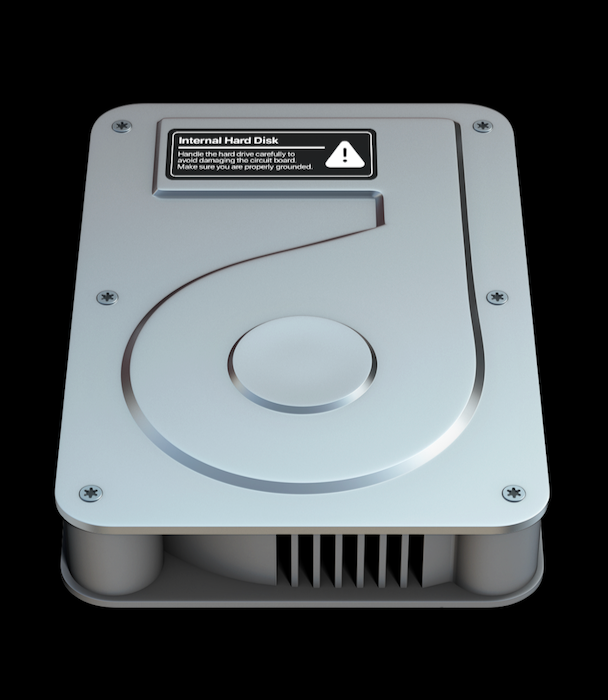 Just before new year I had a problem with the password of one of my Time Machine disks. This was the second instance. Whatever I tried, the disk was not recognized by the MacBook Pro. I still had two disks available for the backups, and a further disk offsite that I rotate with one of the home disks to keep backups up to date. As I am a fan of redundancy, I bought a 2TB SSD disk and that is now used as my 4th Time Machine disk. This week I moved it to the office and took a 2TB Seagate disk home for its Time Machine duties for a day or so.
I took those two password-challenged disks to my office and tried them in the Mac mini there. The disks had never been in the Mac mini before, but when I connected each of them to the computer, I was asked to enter the password. I again tried with what I thought was correct, to no avail. I now had two unusable disks. I wondered, though, if that encryption would work on another platform. One of my colleagues tried both disks in his notebook PC. Neither appeared, although that could have been because they were formatted macOS (journaled). I asked the Electrical Engineering department technician if he could help. As they were at that time, they were useless to me, so if the whole disk could be wiped, at least I would have external media that could be used afresh.
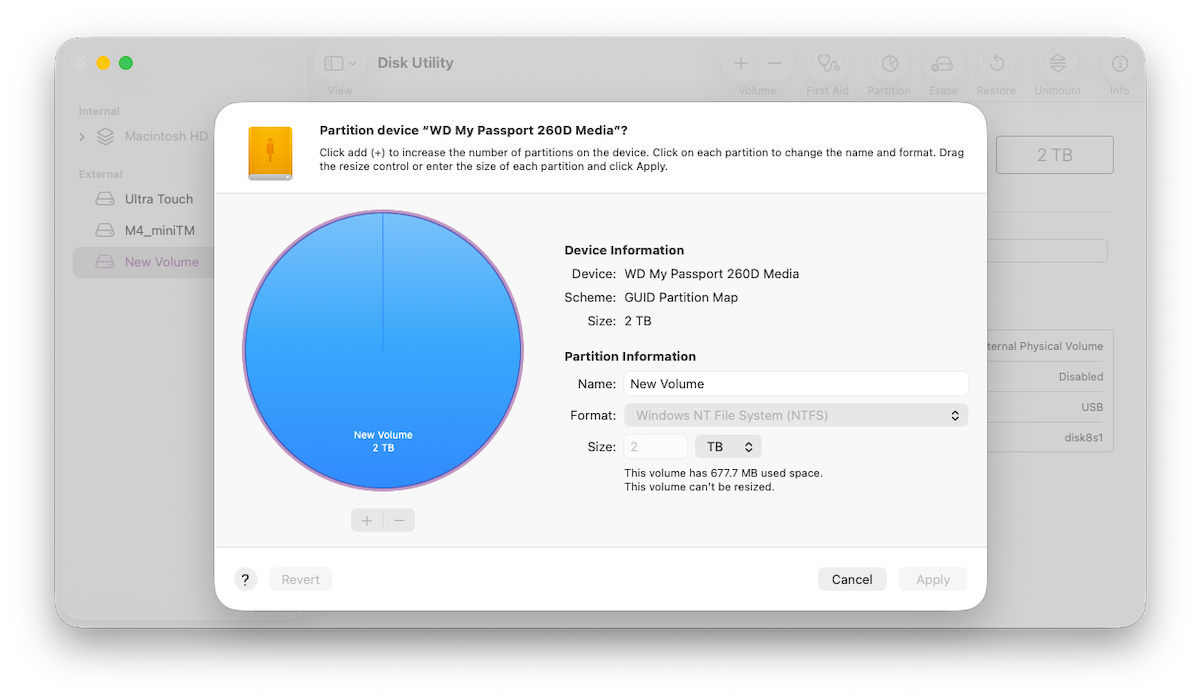
As I was leaving the office last Monday afternoon (5 Jan), he let me know that the job had been done and I could collect them when ready. I called in the next morning and took the disks to the Mac mini. After opening Disk Utility, I connected the first disk. The icon appeared in the sidebar. Information displayed showed a 2TB disk, now called New Volume, with 677.7MB used, formatted in NTFS: Windows NT File System. I repartitioned the disk using macOS (Journaled). I connected the older CalDigit disk, also 2TB. It showed similar information and I repartitioned that in macOS (Journaled) as well. I think I will add one more disk to the Time Machine collection (4 + 1 offsite) and use the other for archive purposes. You never know when you will need a redundant system.
A couple of sources looked at an online essay by Nikita Prokopov (tonsky.me) and both agreed that the new design in macOS26 that provides icons next to all menu items is unnecessary, poorly designed, poorly thought out and not worthy of Apple. John Voorhees (Maccenter) writes that "There's no denying the inconsistencies in icon choices, their lack of legibility, and the overall clutter added to menus." He adds that he has hardly noticed because (like me) he uses keyboard shortcuts most of the time. John Gruber (DaringFireball) comments that it is "Perhaps the epitome of a Dye job." I see also further comments from John Gruber who refers to an the article by Howard Oakley that I cited recently. Can we have our Macs back now?
Further to this, accepting that this could be an article in the run up to Apple's Q1 2026 report, a few sites are reporting that the uptake of iOS 26 is low. One of the articles is from Ed Hardy (Cult of Mac) who links to the source, StatCounter whose table (below) is available for download.
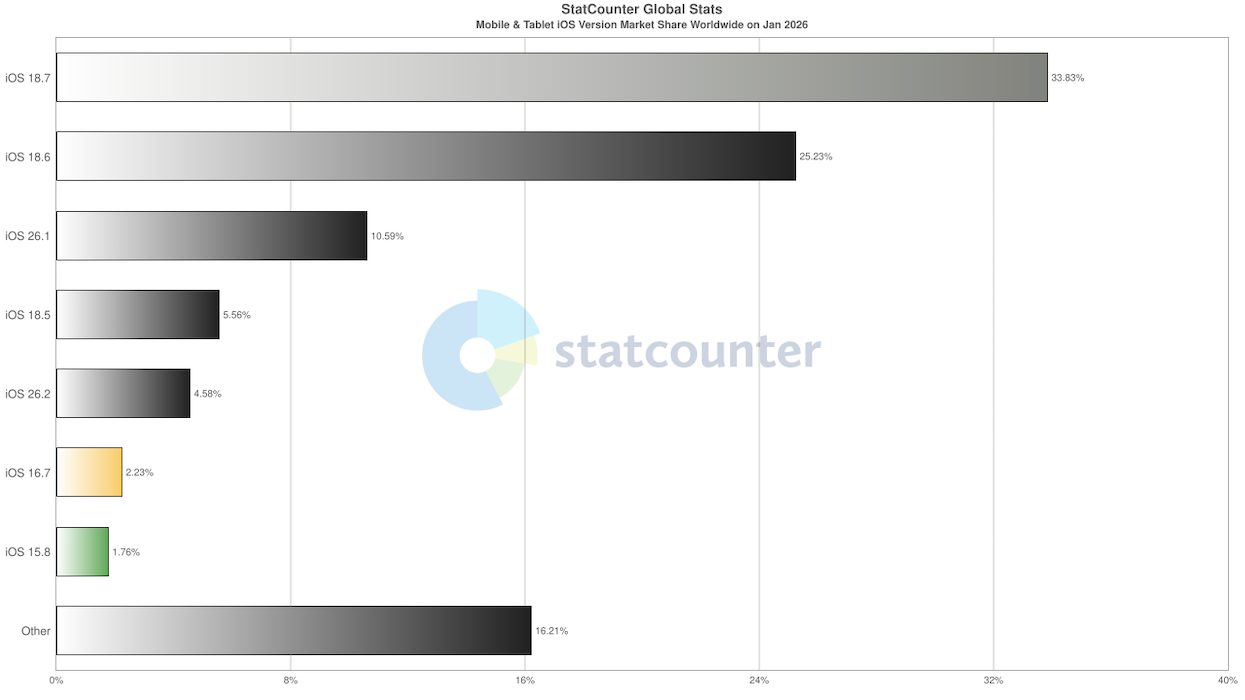
However, Nick Heer (Pixel Envy) follows up with a comment suggesting that the Stat Counter figures may be misleading in the way it collects its data. It uses web data "at massive scale". However, the way this data is collected, as explained by Heer, suggests that the large figures of those not moving to iOS26 could have been skewed. He adds that another source is suggesting a more accurate figure could be an iOS uptake closer to 55%,. This is still lower than earlier versions of iOS.
My early new year has been taken up by reading: a real book. Paper. Ink. Remember? With all the AI dross that I have to look at when I am working, the beautiful flow of Ian McEwan's sentences was delightful. It is perhaps this type of honest input that allows me to see AI output for what it is, even if some of my colleagues think it is good, while also claiming that the content has been checked fully. I saw one recently that was returned from a publisher for further attention and in the 50 or so pages I found a few hundred errors (grammar, word choice, typing) and potential improvements, in a text that I had been assured had been checked. I wish, for one thing, that those who produce such doubtful work would consider that there are other useful alternatives to "crucial".
It is clear that AI includes this word as a matter of course, but few know the true meaning (or the Latin root) of this adjective, which some dictionaries describe as "of supreme importance". The Compact Edition of the Oxford English Dictionary (two massive tomes that sit on my desk) tells me, "That finally decides between two rival hypotheses, proving the one and disproving the other; more loosely, relating to, or adapted to lead to such decision; decisive, critical." There are other words that may be better, depending on context.
The McEwan work, What we Can Know is in two parts. The first outlines the problem area regarding a poem (and those around the poet) from the point of view of researchers 100 or so years in the future when the world has been changed by climate and conflict. The second part uses the journal (presumably honest and factual) to show what really happened, albeit in a work of fiction. Part 1 sets the scene, Part 2 brings it all crashing down delightfully. As well as such works, and much online reading, on occasions I also take the time to read judgements from the English Courts. Despite the importance of such litigation, the words used are valuable examples of clarity: in the structure of the sentences, and the logic of the arguments set out. This is a refreshing change from academic strutting.
I am now off to hospital for a second hip replacement. The left one was done 2 years ago and it is time I had the right one fixed. I will have online resources (iPhone, iPad, et al, plus a notebook (paper) and a copy of Thomas Pynchon's, Shadow Ticket. I hope to be back soon.
Graham K. Rogers teaches at the Faculty of Engineering, Mahidol University in Thailand. He wrote in the Bangkok Post, Database supplement on IT subjects. For the last seven years of Database he wrote a column on Apple and Macs. After 3 years writing a column in the Life supplement, he is now no longer associated with the Bangkok Post. He can be followed on X (@extensions_th). The RSS feed for the articles is http://www.extensions.in.th/ext_link.xml - copy and paste into your feed reader. No AI was used in writing this item.

For further information, e-mail to
Back to
eXtensions
Back to
Home Page